Maths Demo (III) S5 Inequalities Compound Inequality Solve
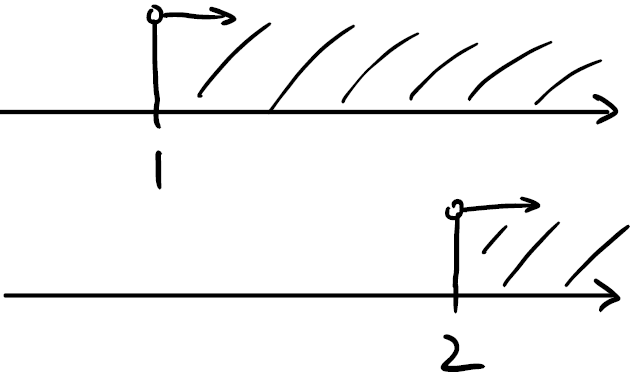
x > 1 x>1 x > 1 x > 2 x>2 x > 2
x > 1 x>1 x > 1 x > 2 x>2 x > 2
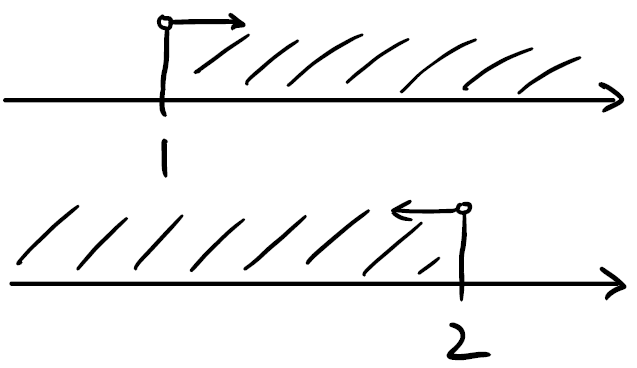
x > 1 x>1 x > 1 x < 2 x<2 x < 2
x > 1 x>1 x > 1 x < 2 x<2 x < 2
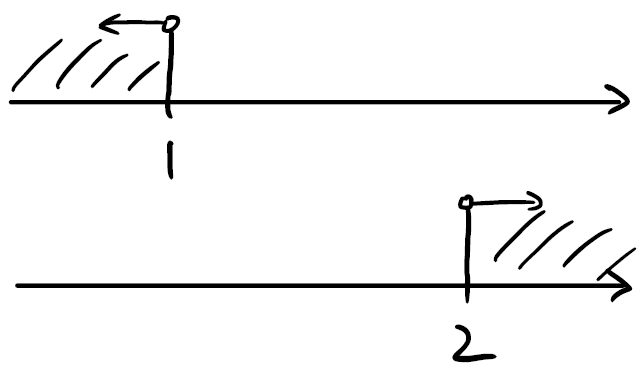
x < 1 x<1 x < 1 x > 2 x>2 x > 2
x < 1 x<1 x < 1 x > 2 x>2 x > 2
Solution
x > 2 x>2 x > 2
x > 1 x>1 x > 1
1 < x < 2 1<x<2 1 < x < 2
all real values
no solution
x < 1 x<1 x < 1 x > 2 x>2 x > 2
Quadratic Inequality Solve
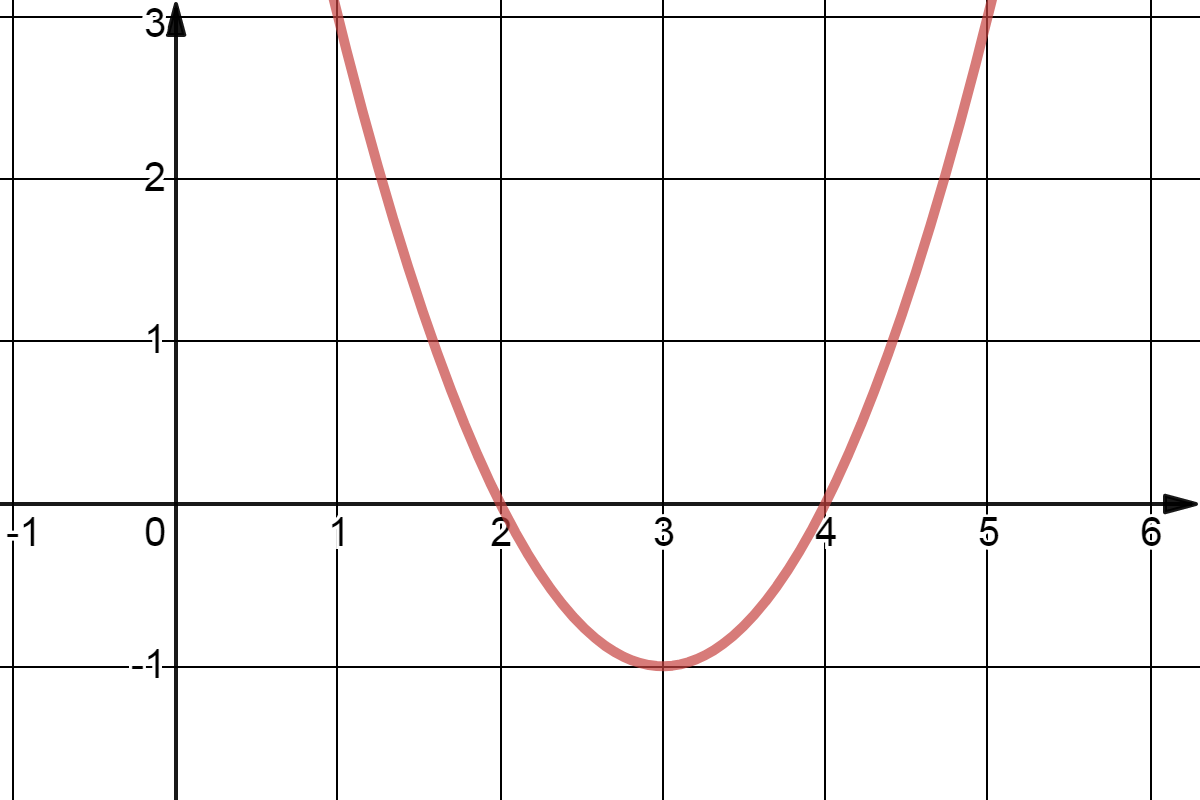
x 2 − 6 x + 8 > 0 x^{2}-6x+8>0 x 2 − 6 x + 8 > 0
x 2 − 6 x + 8 ≤ 0 x^{2}-6x+8\le 0 x 2 − 6 x + 8 ≤ 0
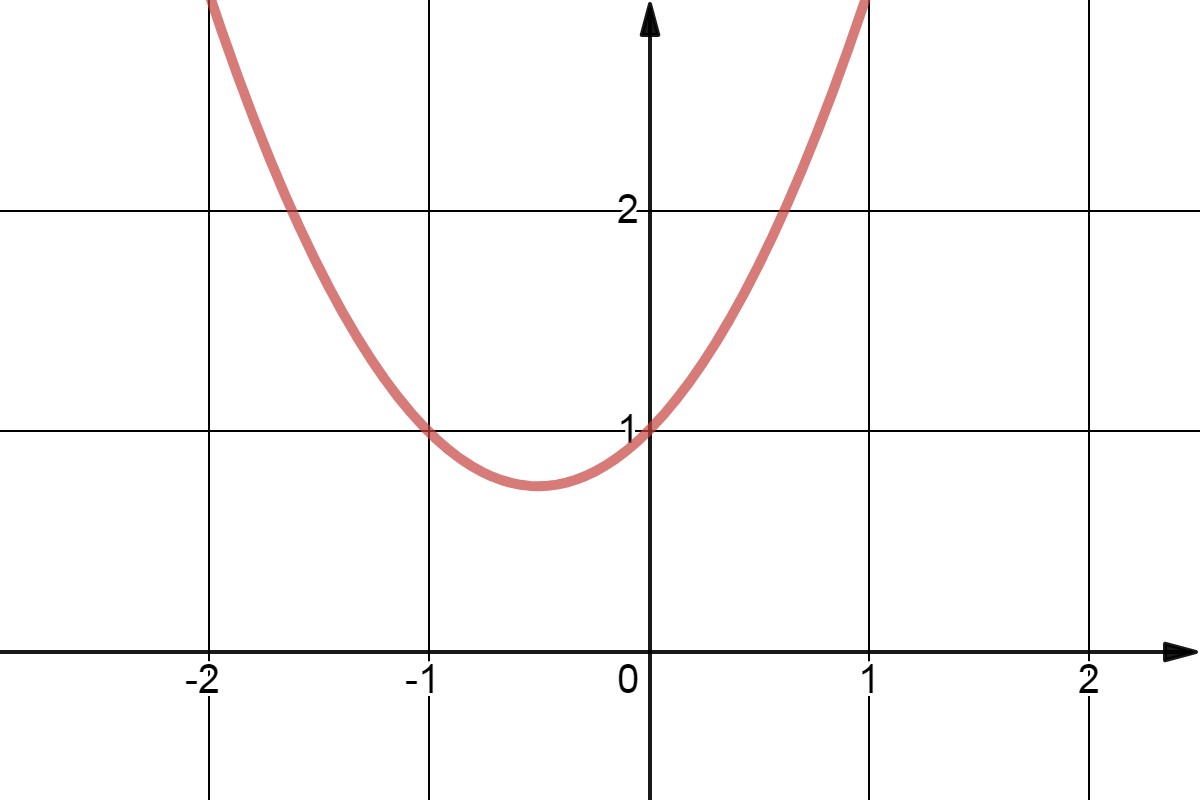
x 2 + x + 1 > 0 x^{2}+x+1>0 x 2 + x + 1 > 0
x 2 + x + 1 ≤ 0 x^{2}+x+1\le 0 x 2 + x + 1 ≤ 0
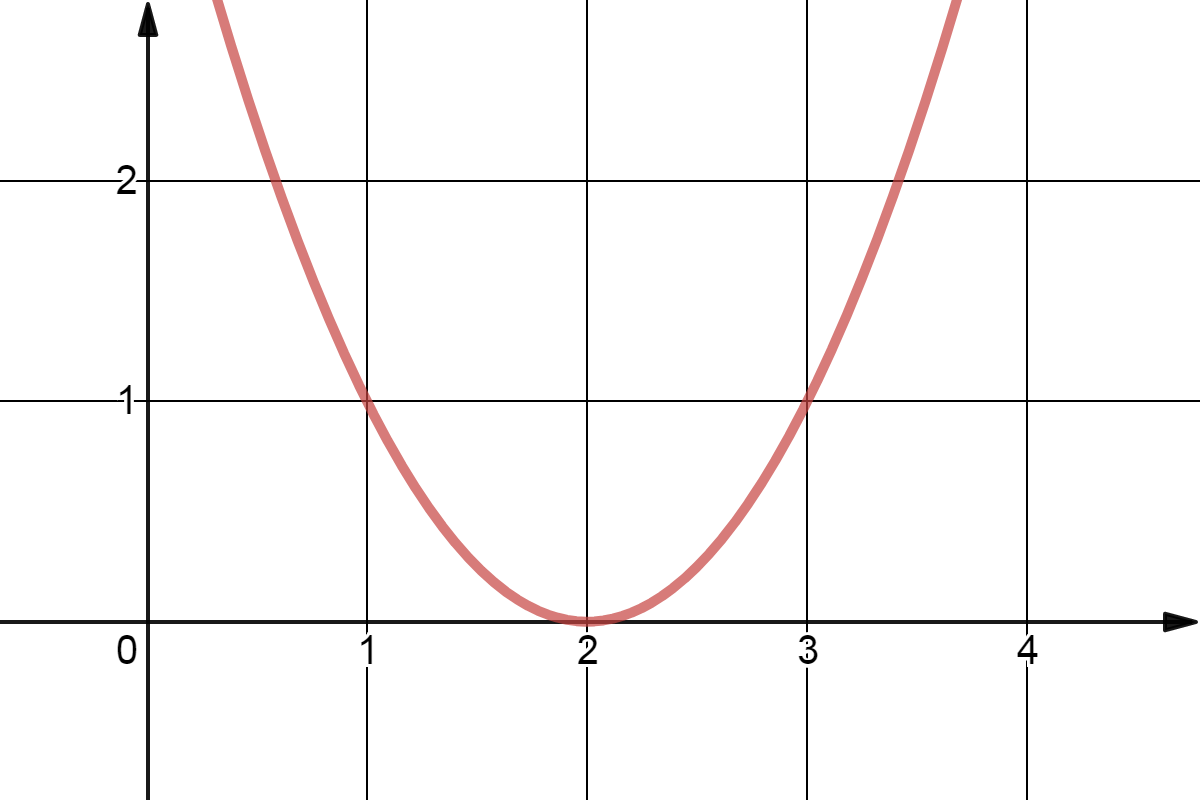
x 2 − 4 x + 4 > 0 x^{2}-4x+4>0 x 2 − 4 x + 4 > 0
x 2 − 4 x + 4 ≤ 0 x^{2}-4x+4\le 0 x 2 − 4 x + 4 ≤ 0
Solution Sketch the graph by knowing the x x x
x < 2 x<2 x < 2 x > 4 x>4 x > 4
2 ≤ x ≤ 4 2\le x\le 4 2 ≤ x ≤ 4
all real values
no solution
all real values except 2
x = 2 x=2 x = 2
S5 Linear Programming Optimization Problem A worker makes x x x y y y
Wood Required Time Required Profit Made Chair 2 units 1 hour $10 Table 3 units 1 hour $20
The worker has 24 units of wood and works for at most 10 hours a day.
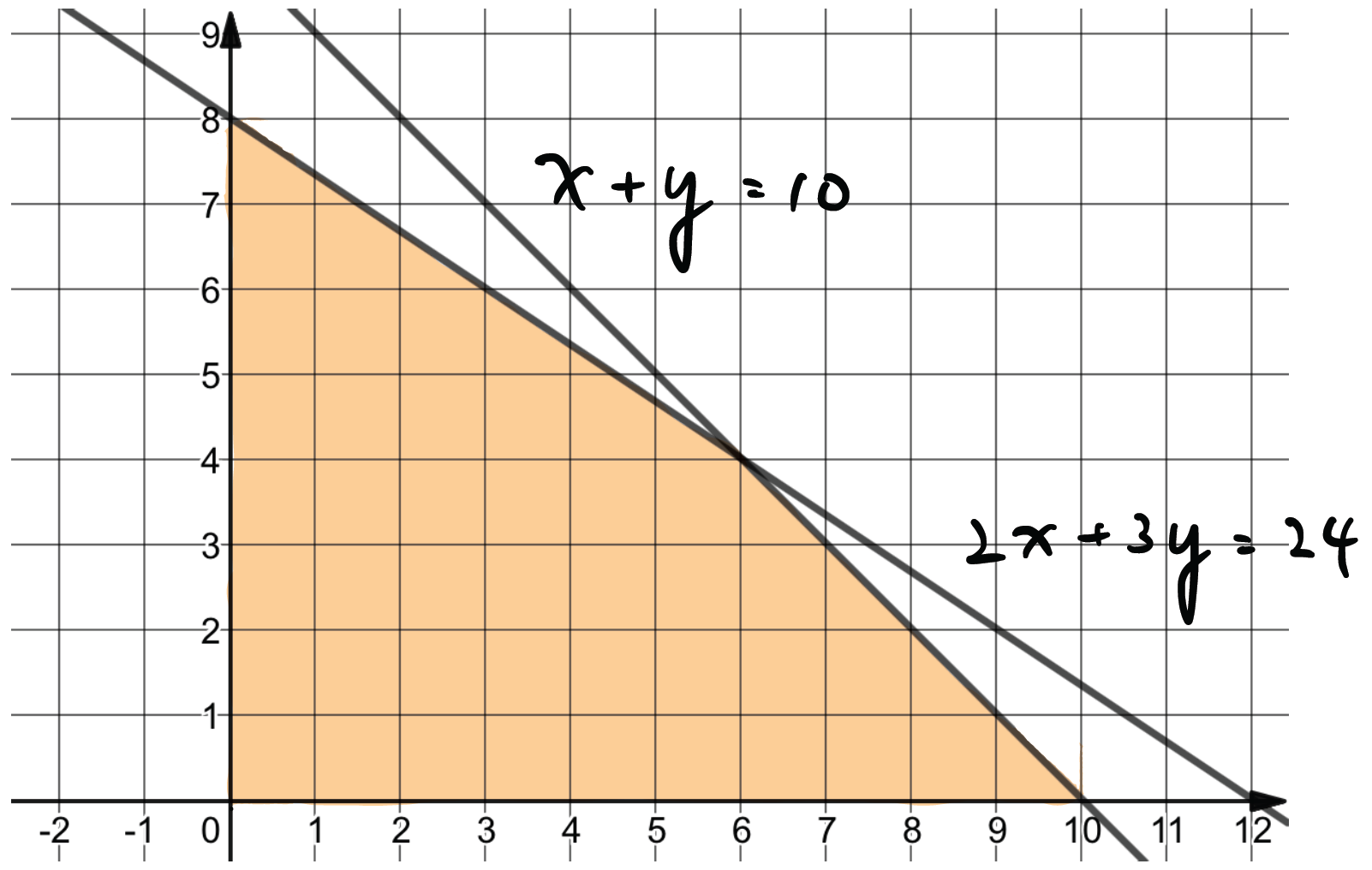
Method 1: Parallel Line Shifting Constraints: { 2 x + 3 y ≤ 24 x + y ≤ 10 x , y are non-negative integers \left\{ \begin{aligned} &2x+3y\le 24 \\ &x+y\le 10 \\ &x,\ y \text{ are non-negative integers} \end{aligned} \right. ⎩ ⎨ ⎧ 2 x + 3 y ≤ 24 x + y ≤ 10 x , y are non-negative integers
The profit P = 10 x + 20 y P=10x+20y P = 10 x + 20 y
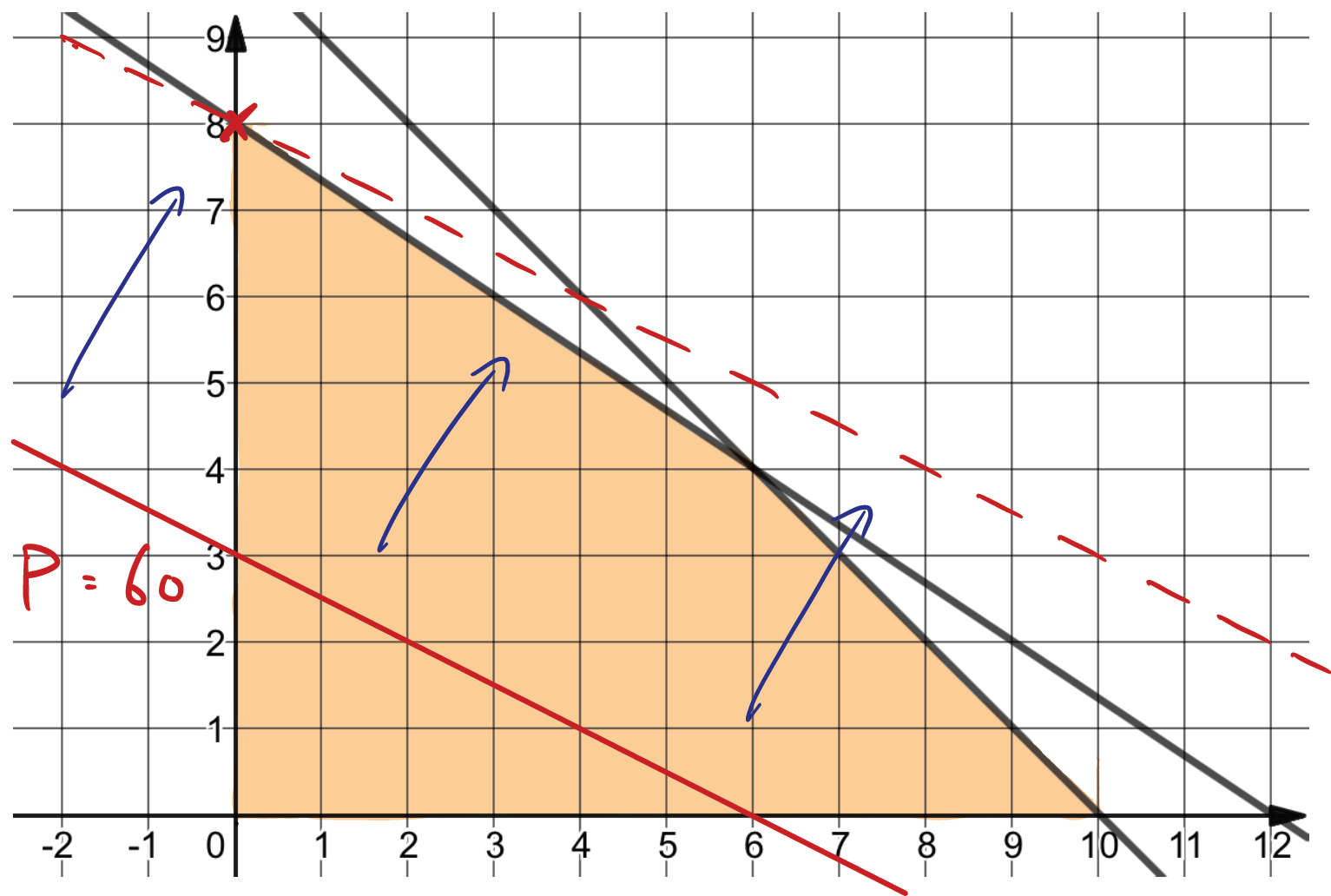
Draw the line P = 60 P=60 P = 60 10 x + 20 y = 60 10x+20y=60 10 x + 20 y = 60
By shifting the line, we find that the max of P P P ( 0 , 8 ) (0, 8) ( 0 , 8 )
∴ max profit = 10 ( 0 ) + 20 ( 8 ) = $ 160 \begin{aligned} \text{max profit} &= 10(0)+20(8) \\ &= \$160 \end{aligned} max profit = 10 ( 0 ) + 20 ( 8 ) = $160
Method 2: Checking Vertices Constraints: { 2 x + 3 y ≤ 24 x + y ≤ 10 x , y are non-negative integers \left\{ \begin{aligned} &2x+3y\le 24 \\ &x+y\le 10 \\ &x,\ y \text{ are non-negative integers} \end{aligned} \right. ⎩ ⎨ ⎧ 2 x + 3 y ≤ 24 x + y ≤ 10 x , y are non-negative integers
The profit P = 10 x + 20 y P=10x+20y P = 10 x + 20 y
There are 4 vertices:
At ( 0 , 0 ) (0, 0) ( 0 , 0 ) P = 10 ( 0 ) + 20 ( 0 ) = $ 0 \begin{aligned} P &= 10(0)+20(0) \\ &= \$0 \end{aligned} P = 10 ( 0 ) + 20 ( 0 ) = $0
At ( 0 , 8 ) (0, 8) ( 0 , 8 ) P = 10 ( 0 ) + 20 ( 8 ) = $ 160 \begin{aligned} P &= 10(0)+20(8) \\ &= \$160 \end{aligned} P = 10 ( 0 ) + 20 ( 8 ) = $160
At ( 6 , 4 ) (6, 4) ( 6 , 4 ) P = 10 ( 6 ) + 20 ( 4 ) = $ 140 \begin{aligned} P &= 10(6)+20(4) \\ &= \$140 \end{aligned} P = 10 ( 6 ) + 20 ( 4 ) = $140
At ( 10 , 0 ) (10, 0) ( 10 , 0 ) P = 10 ( 10 ) + 20 ( 0 ) = $ 100 \begin{aligned} P &= 10(10)+20(0) \\ &= \$100 \end{aligned} P = 10 ( 10 ) + 20 ( 0 ) = $100
∴ max profit = $ 160 =\$160 = $160
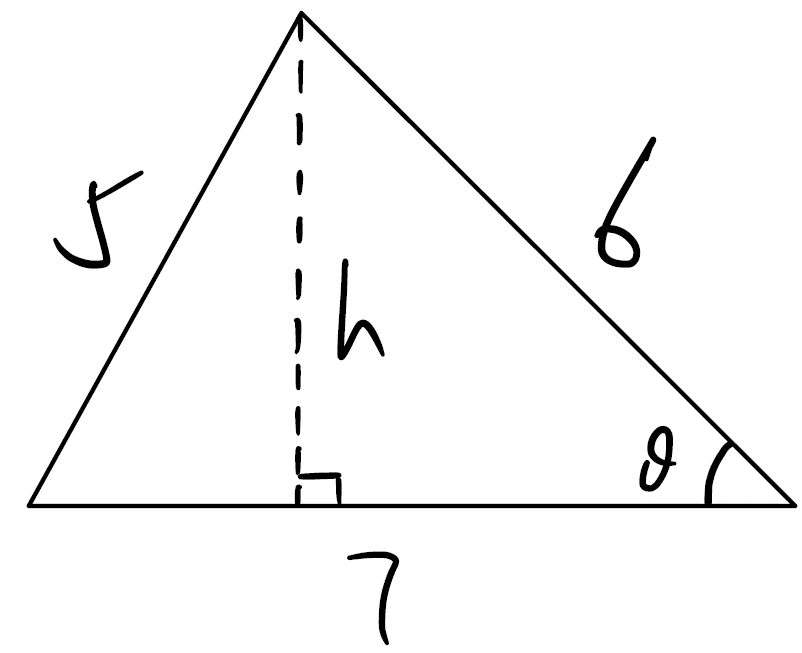
S5 Solving Triangles Height of a Solvable Triangle Find the height h h h
Method 1: By Area (倒積求高) By Heron’s formula, its area = 14.69693846
∴ 1 2 ( 7 ) ( h ) = 14.69693846 h = 4.20 \begin{aligned} \dfrac{1}{2}(7)(h) &= 14.69693846 \\ h &= 4.20 \end{aligned} 2 1 ( 7 ) ( h ) h = 14.69693846 = 4.20
Method 2: By Angle By Cosine law, θ = 44.4153086 ° θ=44.4153086° θ = 44.4153086°
∴ sin θ = h 6 h = 4.20 \begin{aligned} \sinθ &= \dfrac{h}{6} \\ h &= 4.20 \end{aligned} sin θ h = 6 h = 4.20
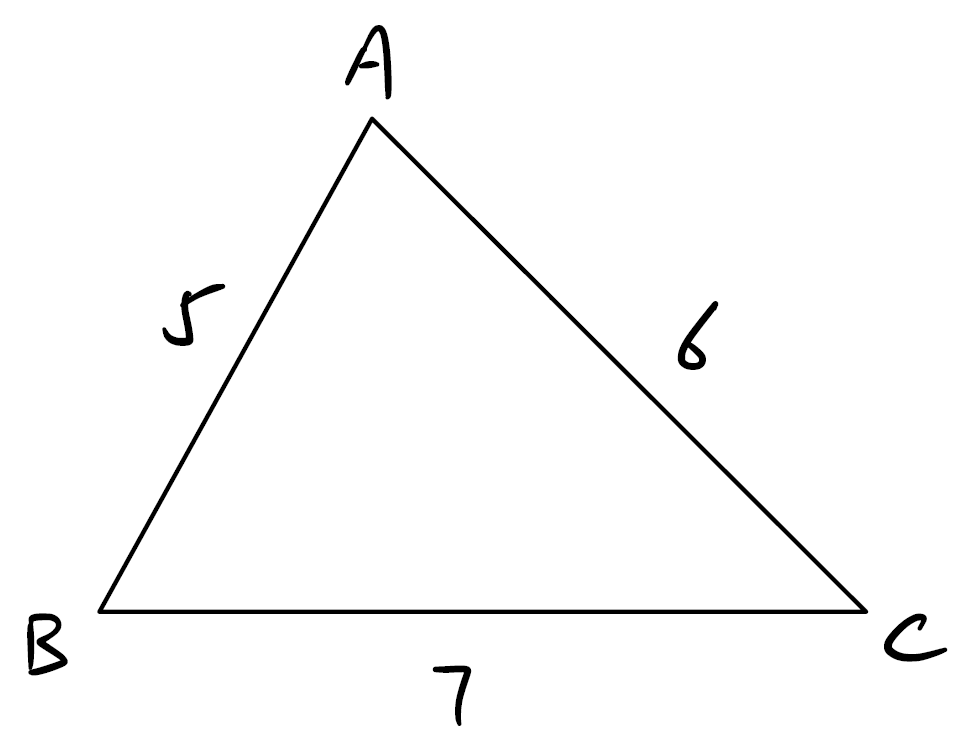
In-radius of a Triangle Find the in-radius of this triangle.
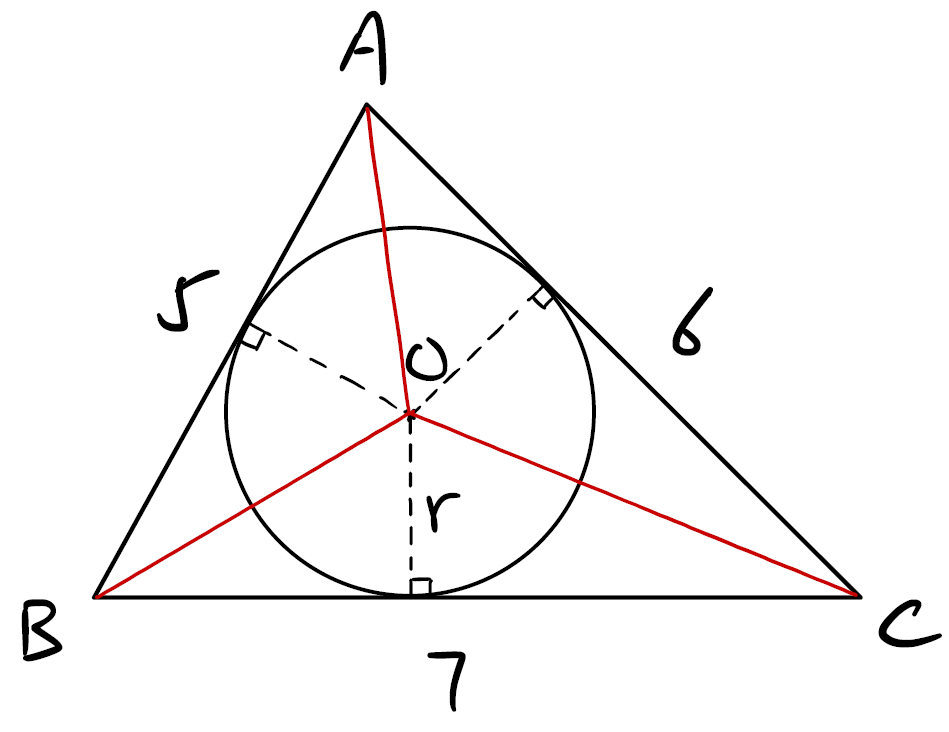
Solution The in-radius is the radius r r r
By Heron’s formula, area of △ A B C = 14.69693846 \triangle ABC=14.69693846 △ A B C = 14.69693846
We can cut △ A B C \triangle ABC △ A B C △ A O B \triangle AOB △ A O B △ B O C \triangle BOC △ B O C △ C O A \triangle COA △ C O A r r r
∴ 1 2 ( 5 ) ( r ) + 1 2 ( 7 ) ( r ) + 1 2 ( 6 ) ( r ) = 14.69693846 r = 1.63 \begin{aligned} \dfrac{1}{2}(5)(r)+\dfrac{1}{2}(7)(r)+\dfrac{1}{2}(6)(r) &= 14.69693846 \\ r &= 1.63 \end{aligned} 2 1 ( 5 ) ( r ) + 2 1 ( 7 ) ( r ) + 2 1 ( 6 ) ( r ) r = 14.69693846 = 1.63
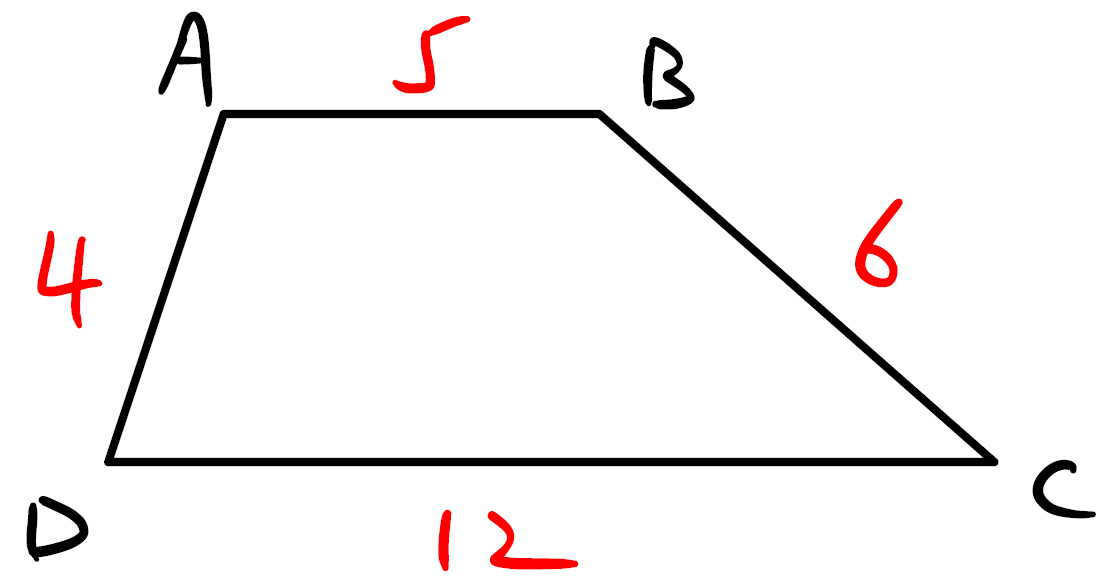
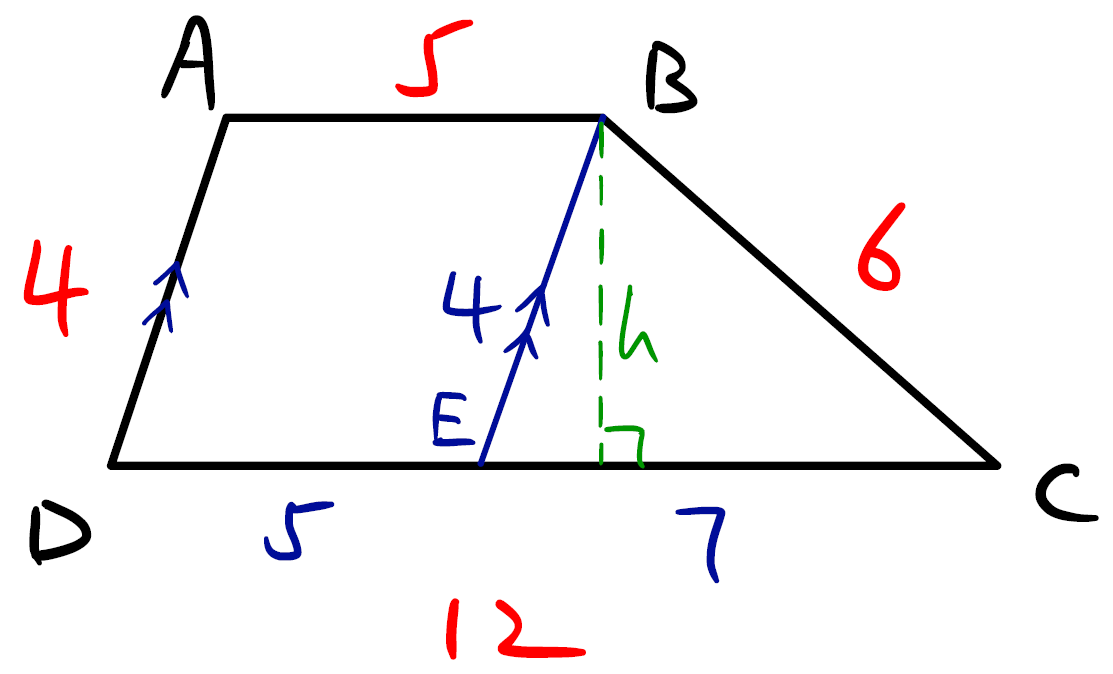
Solve a Trapezium Find the area of this trapezium.
Solution Add point E E E C D CD C D A D AD A D B E BE B E
B E = A D = 4 D E = A B = 5 C E = 12 − 5 = 7 \begin{aligned} BE &= AD \\ &= 4 \\ DE &= AB \\ &= 5 \\ CE &= 12-5 \\ &= 7 \end{aligned} B E D E C E = A D = 4 = A B = 5 = 12 − 5 = 7
By finding the height of △ B C E \triangle BCE △ B C E h = 3.421868448 h=3.421868448 h = 3.421868448
∴ Area = ( 5 + 12 ) h 2 = 29.1 \begin{aligned} \text{Area} &= \dfrac{(5+12)h}{2} \\ &= 29.1 \end{aligned} Area = 2 ( 5 + 12 ) h = 29.1
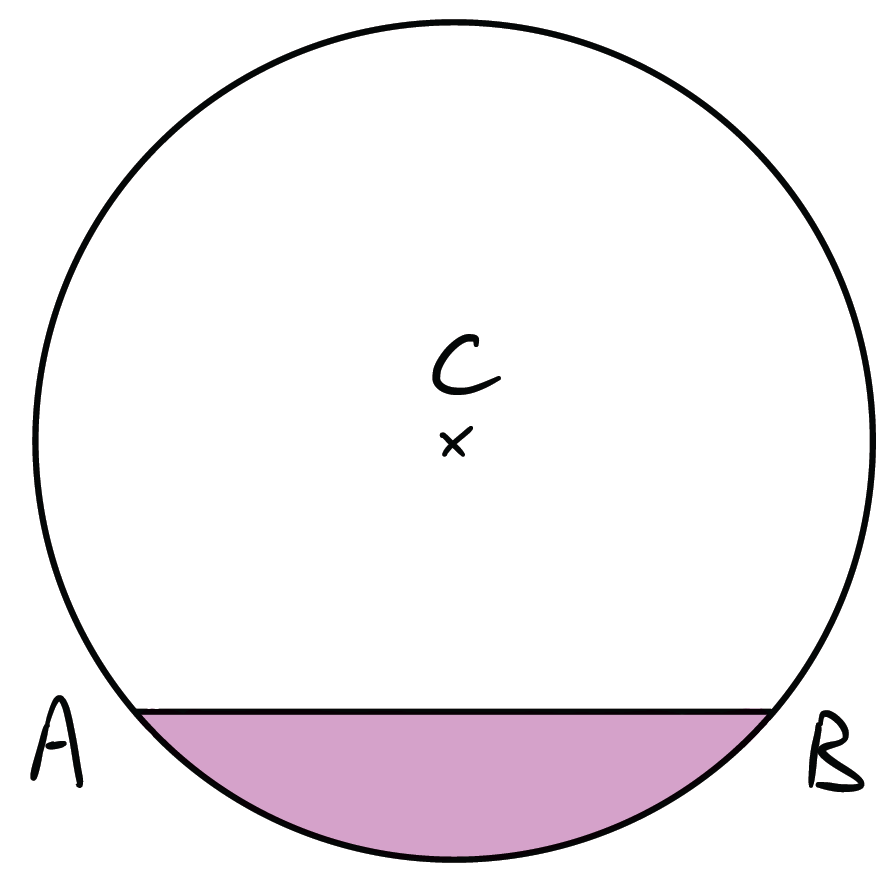
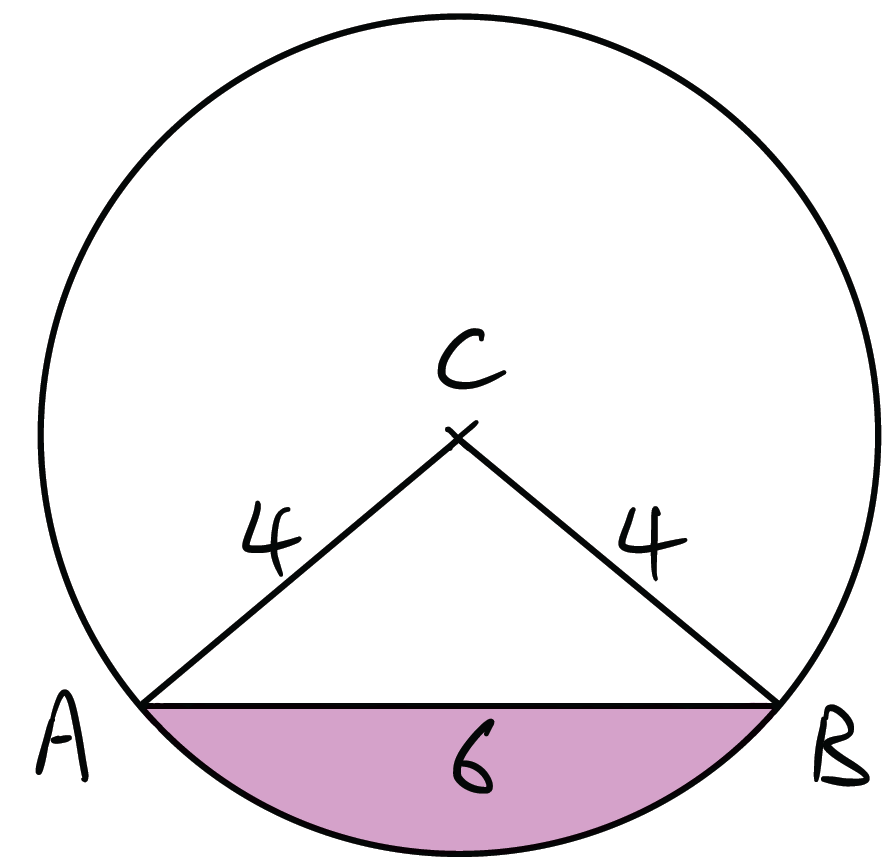
Area of a Circle Segment The radius of the circle is 4 and A B = 6 AB=6 A B = 6 A B AB A B
Solution Solve △ A B C \triangle ABC △ A B C θ = 97.18075578 θ=97.18075578 θ = 97.18075578 = 7.937253933 =7.937253933 = 7.937253933
area of sector A B C = π r 2 × θ 360 ° = 13.56899326 \begin{aligned} \text{area of sector } ABC &= π r^{2}\times\dfrac{θ}{360°} \\ &= 13.56899326 \end{aligned} area of sector A B C = π r 2 × 360° θ = 13.56899326
∴ area of shaded segment = 13.56899326 − 7.937253933 = 5.63 \begin{aligned} \text{area of shaded segment} &= 13.56899326-7.937253933 \\ &= 5.63 \end{aligned} area of shaded segment = 13.56899326 − 7.937253933 = 5.63
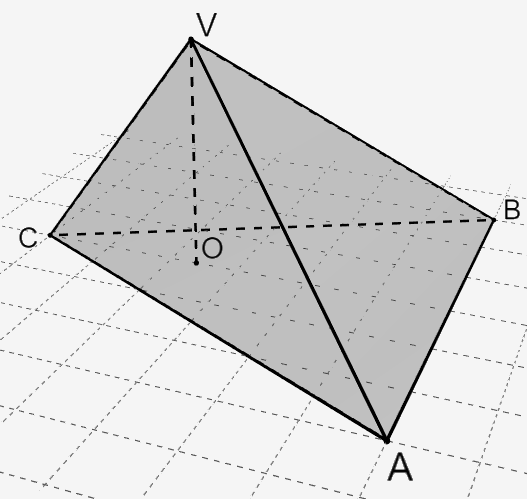
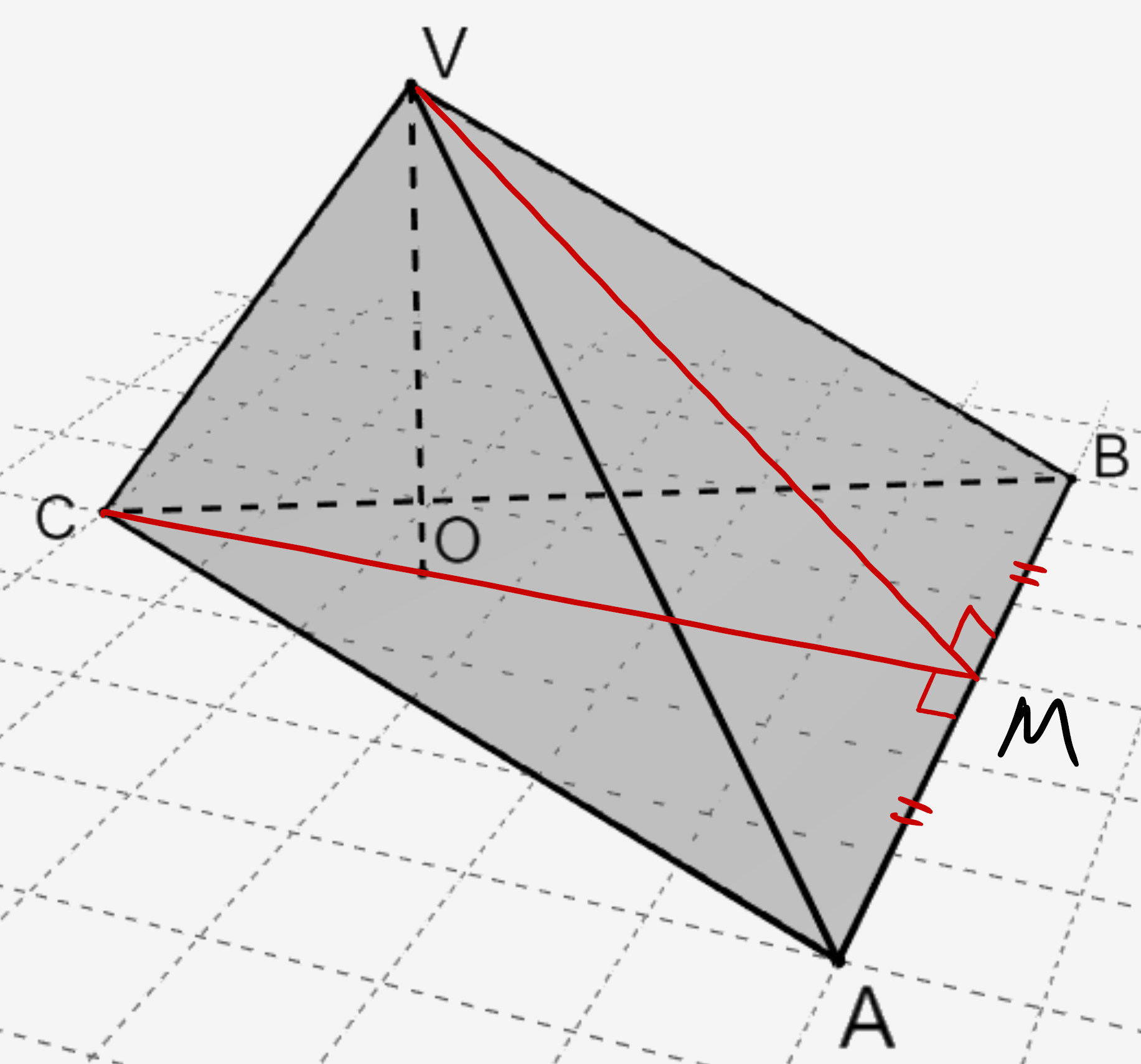
S5 3D Geometry Height of a Symmetrical Tetrahedron Consider a tetrahedron with A C = B C = 35 AC=BC=35 A C = B C = 35 V A = V B = 29 VA=VB=29 V A = V B = 29 V C = 15 VC=15 V C = 15 A B = 42 AB=42 A B = 42 O V OV O V
Solution Let M M M A B AB A B
Note that the tetrahedron is symmetrical about the plane V M C VMC V M C
By finding the height of △ V A B \triangle VAB △ V A B V M = 20 VM=20 V M = 20
By finding the height of △ C A B \triangle CAB △ C A B C M = 28 CM=28 C M = 28
By finding the height of △ V M C \triangle VMC △ V M C O V = 10.3 OV=10.3 O V = 10.3
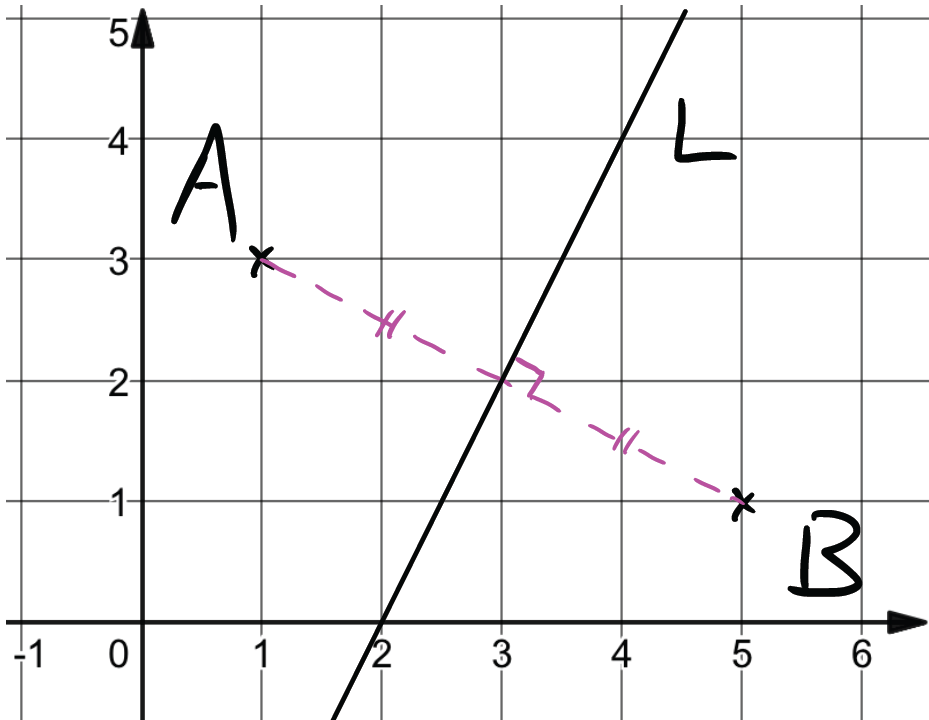
S5 Locus Equation of a Perpendicular Bisector Given A ( 1 , 3 ) A(1, 3) A ( 1 , 3 ) B ( 5 , 1 ) B(5, 1) B ( 5 , 1 ) A B AB A B
Method 1: By Mid-pt and Slope L L L A B AB A B A B AB A B
M M M A B AB A B ( 1 + 5 2 , 3 + 1 2 ) \left(\dfrac{1+5}{2},\dfrac{3+1}{2}\right) ( 2 1 + 5 , 2 3 + 1 ) ( 3 , 2 ) (3, 2) ( 3 , 2 )
∵ L ⊥ A B L\perp AB L ⊥ A B
∴ m L × m A B = − 1 m L × 1 − 3 5 − 1 = − 1 m L = 2 \begin{aligned} m_{L}\times m_{AB} &= -1 \\ m_{L}\times\dfrac{1-3}{5-1} &= -1 \\ m_{L} &= 2 \end{aligned} m L × m A B m L × 5 − 1 1 − 3 m L = − 1 = − 1 = 2
∴ y − 2 x − 3 = 2 y = 2 x − 4 \begin{aligned} \dfrac{y-2}{x-3} &= 2 \\ y &= 2x-4 \end{aligned} x − 3 y − 2 y = 2 = 2 x − 4
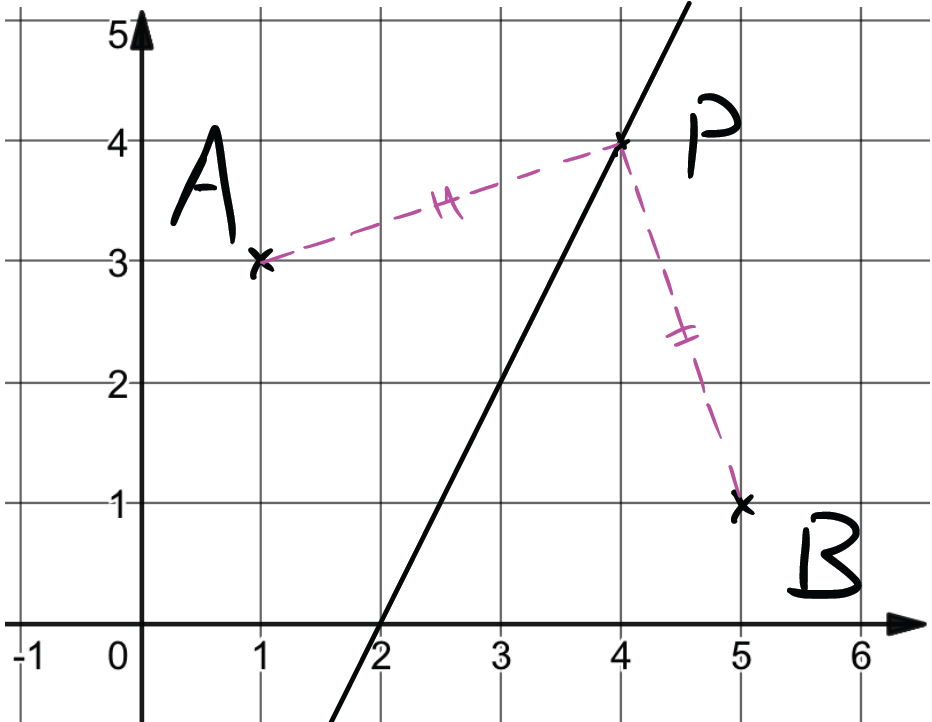
Method 2: By Equidistant Any point P ( x , y ) P(x, y) P ( x , y ) A A A B B B
P A = P B ( x − 1 ) 2 + ( y − 3 ) 2 = ( x − 5 ) 2 + ( y − 1 ) 2 ( x − 1 ) 2 + ( y − 3 ) 2 = ( x − 5 ) 2 + ( y − 1 ) 2 x 2 − 2 x + 1 + y 2 − 6 y + 9 = x 2 − 10 x + 25 + y 2 − 2 y + 1 − 2 x − 6 y + 10 = − 10 x − 2 y + 26 y = 2 x − 4 \begin{aligned} PA &= PB \\ \sqrt{(x-1)^{2}+(y-3)^{2}} &= \sqrt{(x-5)^{2}+(y-1)^{2}} \\ (x-1)^{2}+(y-3)^{2} &= (x-5)^{2}+(y-1)^{2} \\ x^{2}-2x+1+y^{2}-6y+9 &= x^{2}-10x+25+y^{2}-2y+1 \\ -2x-6y+10 &= -10x-2y+26 \\ y &= 2x-4 \end{aligned} P A ( x − 1 ) 2 + ( y − 3 ) 2 ( x − 1 ) 2 + ( y − 3 ) 2 x 2 − 2 x + 1 + y 2 − 6 y + 9 − 2 x − 6 y + 10 y = P B = ( x − 5 ) 2 + ( y − 1 ) 2 = ( x − 5 ) 2 + ( y − 1 ) 2 = x 2 − 10 x + 25 + y 2 − 2 y + 1 = − 10 x − 2 y + 26 = 2 x − 4
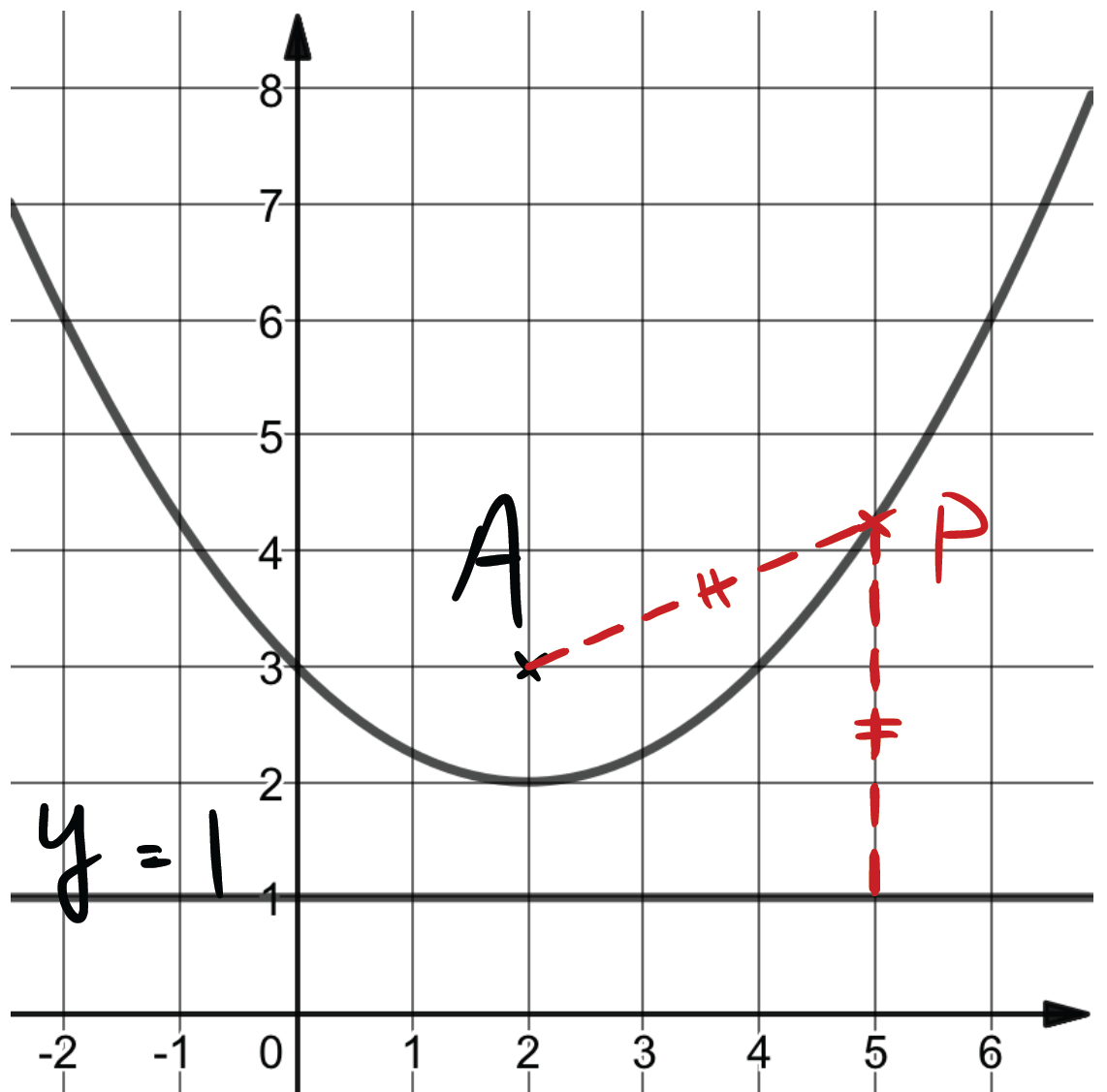
Equation of a Parabolic Locus P P P A ( 2 , 3 ) A(2, 3) A ( 2 , 3 ) L L L y = 1 y=1 y = 1 Γ Γ Γ P P P
Solution Let P = ( x , y ) P=(x, y) P = ( x , y )
P A = distance from P to L ( x − 2 ) 2 + ( y − 3 ) 2 = y − 1 ( x − 2 ) 2 + ( y − 3 ) 2 = ( y − 1 ) 2 x 2 − 4 x + 4 + y 2 − 6 y + 9 = y 2 − 2 y + 1 x 2 − 4 x + 12 = 4 y y = 1 4 x 2 − x + 3 \begin{aligned} PA &= \text{distance from } P \text{ to } L \\ \sqrt{(x-2)^{2}+(y-3)^{2}} &= y-1 \\ (x-2)^{2}+(y-3)^{2} &= (y-1)^{2} \\ x^{2}-4x+4+y^{2}-6y+9 &= y^{2}-2y+1 \\ x^{2}-4x+12 &= 4y \\ y &= \dfrac{1}{4}x^{2}-x+3 \end{aligned} P A ( x − 2 ) 2 + ( y − 3 ) 2 ( x − 2 ) 2 + ( y − 3 ) 2 x 2 − 4 x + 4 + y 2 − 6 y + 9 x 2 − 4 x + 12 y = distance from P to L = y − 1 = ( y − 1 ) 2 = y 2 − 2 y + 1 = 4 y = 4 1 x 2 − x + 3
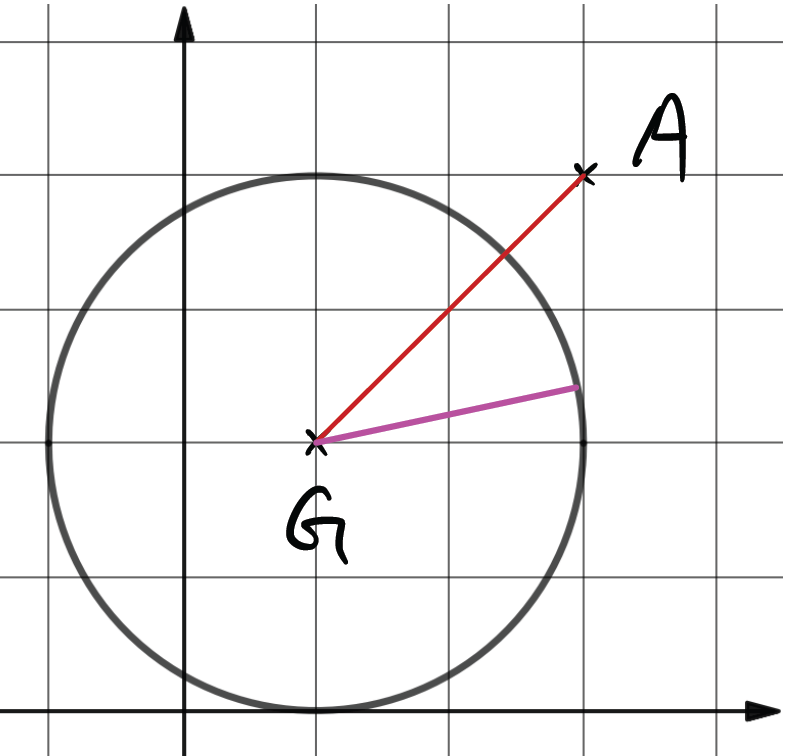
S5 Equation of Circle Determine whether a Point is Inside / Outside a Circle Determine whether A ( 3 , 4 ) A(3, 4) A ( 3 , 4 ) ( x − 1 ) 2 + ( y − 2 ) 2 = 4 (x-1)^{2}+(y-2)^{2}=4 ( x − 1 ) 2 + ( y − 2 ) 2 = 4
Solution Compare A G AG A G r r r
A G < r AG<r A G < r A G = r AG=r A G = r A G > r AG>r A G > r The centre of the circle is G ( 1 , 2 ) G(1, 2) G ( 1 , 2 )
The radius r r r 4 = 2 \sqrt{4}=2 4 = 2
distance A G = ( 3 − 1 ) 2 + ( 4 − 2 ) 2 = 2.83 > r \begin{aligned} AG &= \sqrt{(3-1)^{2}+(4-2)^{2}} \\ &= 2.83 \\ &> r \end{aligned} A G = ( 3 − 1 ) 2 + ( 4 − 2 ) 2 = 2.83 > r
∴ A A A
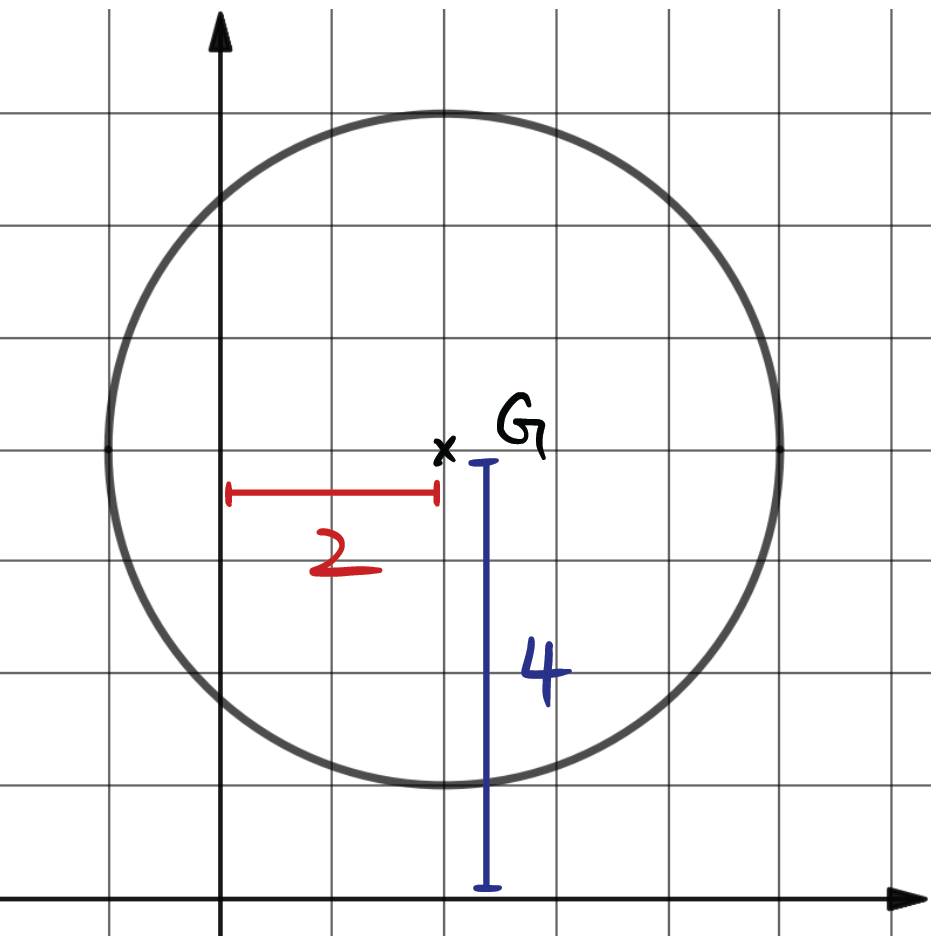
Determine whether a Circle Cuts the x -axis / y -axis Determine whether the circle ( x − 2 ) 2 + ( y − 4 ) 2 = 9 (x-2)^{2}+(y-4)^{2}=9 ( x − 2 ) 2 + ( y − 4 ) 2 = 9 x x x y y y
Method 1: Compare with Radius centre G = ( 2 , 4 ) G=(2, 4) G = ( 2 , 4 ) radius r = 9 = 3 \begin{aligned} \text{radius } r &= \sqrt{9} \\ &= 3 \end{aligned} radius r = 9 = 3 G G G x x x = 4 > r =4>r = 4 > r x x x G G G y y y = 2 < r =2<r = 2 < r y y y
Method 2: Try to Find Intercepts Find x x x y = 0 y=0 y = 0
( x − 2 ) 2 + ( 0 − 4 ) 2 = 9 x 2 − 4 x + 11 = 0 \begin{aligned} (x-2)^{2}+(0-4)^{2} &= 9 \\ x^{2}-4x+11 &= 0 \end{aligned} ( x − 2 ) 2 + ( 0 − 4 ) 2 x 2 − 4 x + 11 = 9 = 0
No real root
∴ There are no x x x x x x
Find y y y x = 0 x=0 x = 0
( 0 − 2 ) 2 + ( y − 4 ) 2 = 9 y 2 − 8 y + 11 = 0 y = 1.76 or 6.24 \begin{aligned} (0-2)^{2}+(y-4)^{2} &= 9 \\ y^{2}-8y+11 &= 0 \\ y &= 1.76 \text{ or } 6.24 \end{aligned} ( 0 − 2 ) 2 + ( y − 4 ) 2 y 2 − 8 y + 11 y = 9 = 0 = 1.76 or 6.24
∴ There are 2 y y y y y y
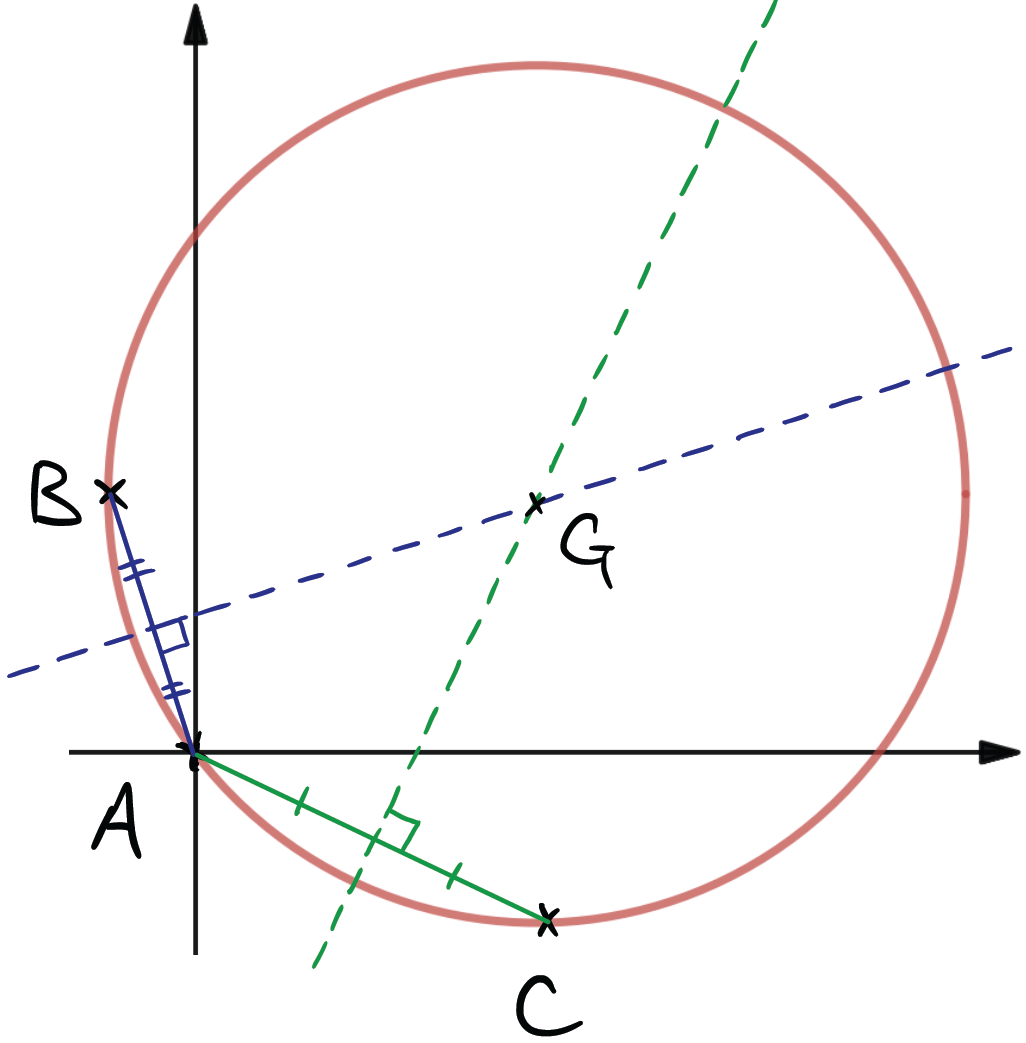
Equation of a Circle Through 3 Given Points (三點共圓) Find the equation of the circle which passes through A ( 0 , 0 ) A(0, 0) A ( 0 , 0 ) B ( − 2 , 6 ) B(-2, 6) B ( − 2 , 6 ) C ( 8 , − 4 ) C(8, -4) C ( 8 , − 4 )
Method 1: By Perpendicular Bisector of Chord Find the perpendicular bisector of A B AB A B A C AC A C
{ ⊥ bisector of A B : y = 1 3 x + 10 3 . . . ( 1 ) ⊥ bisector of A C : y = 2 x − 10 . . . ( 2 ) \left\{ \begin{aligned} \perp \text{ bisector of } AB&: y=\dfrac{1}{3}x+\dfrac{10}{3} && ...(1) \\ \perp \text{ bisector of } AC&: y=2x-10 && ...(2) \end{aligned} \right. ⎩ ⎨ ⎧ ⊥ bisector of A B ⊥ bisector of A C : y = 3 1 x + 3 10 : y = 2 x − 10 ... ( 1 ) ... ( 2 )
Solving (1) and (2), centre G = ( 8 , 6 ) G=(8, 6) G = ( 8 , 6 ) G G G
radius = G A = ( 8 − 0 ) 2 + ( 6 − 0 ) 2 = 10 \begin{aligned} \text{radius} &= GA \\ &= \sqrt{(8-0)^{2}+(6-0)^{2}} \\ &= 10 \end{aligned} radius = G A = ( 8 − 0 ) 2 + ( 6 − 0 ) 2 = 10
∴ The equation is ( x − 8 ) 2 + ( y − 6 ) 2 = 100 (x-8)^{2}+(y-6)^{2}=100 ( x − 8 ) 2 + ( y − 6 ) 2 = 100
Method 2: By Substituting Points Only use this method when one of the points is (0, 0)
Let the equation be x 2 + y 2 + D x + E y + F = 0 x^{2}+y^{2}+Dx+Ey+F=0 x 2 + y 2 + D x + E y + F = 0
Put A ( 0 , 0 ) A(0, 0) A ( 0 , 0 )
0 2 + 0 2 + D ( 0 ) + E ( 0 ) + F = 0 F = 0 \begin{aligned} 0^{2}+0^{2}+D(0)+E(0)+F &= 0 \\ F &= 0 \end{aligned} 0 2 + 0 2 + D ( 0 ) + E ( 0 ) + F F = 0 = 0
∴ The equation is x 2 + y 2 + D x + E y = 0 x^{2}+y^{2}+Dx+Ey=0 x 2 + y 2 + D x + E y = 0
Put B ( − 2 , 6 ) B(-2, 6) B ( − 2 , 6 ) C ( 8 , − 4 ) C(8, -4) C ( 8 , − 4 )
{ ( − 2 ) 2 + 6 2 + D ( − 2 ) + E ( 6 ) = 0 8 2 + ( − 4 ) 2 + D ( 8 ) + E ( − 4 ) = 0 → { − 2 D + 6 E = − 40 8 D − 4 E = − 80 → { D = − 16 E = − 12 \left\{ \begin{aligned} (-2)^{2}+6^{2}+D(-2)+E(6) &= 0 \\ 8^{2}+(-4)^{2}+D(8)+E(-4) &= 0 \end{aligned} \right. \to \left\{ \begin{aligned} -2D+6E &= -40 \\ 8D-4E &= -80 \end{aligned} \right. \to \left\{ \begin{aligned} D &= -16 \\ E &= -12 \end{aligned} \right. { ( − 2 ) 2 + 6 2 + D ( − 2 ) + E ( 6 ) 8 2 + ( − 4 ) 2 + D ( 8 ) + E ( − 4 ) = 0 = 0 → { − 2 D + 6 E 8 D − 4 E = − 40 = − 80 → { D E = − 16 = − 12
∴ The equation is x 2 + y 2 − 16 x − 12 y = 0 x^{2}+y^{2}-16x-12y=0 x 2 + y 2 − 16 x − 12 y = 0
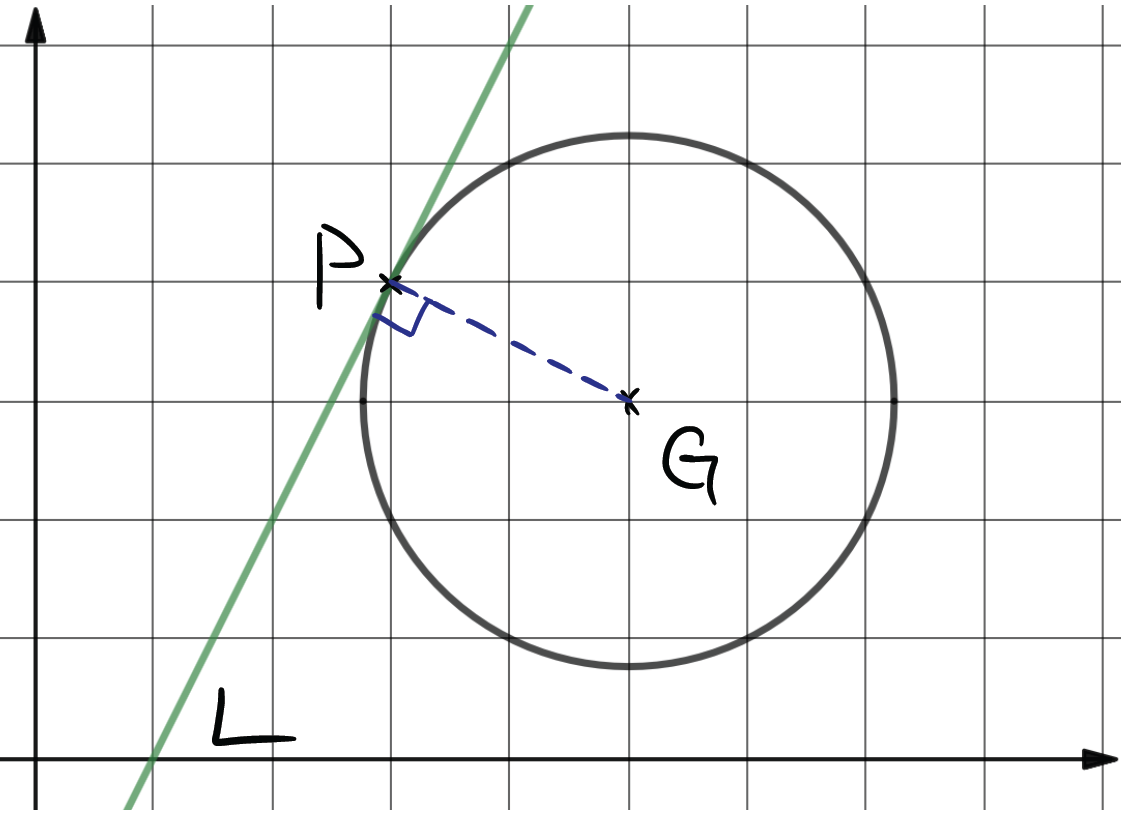
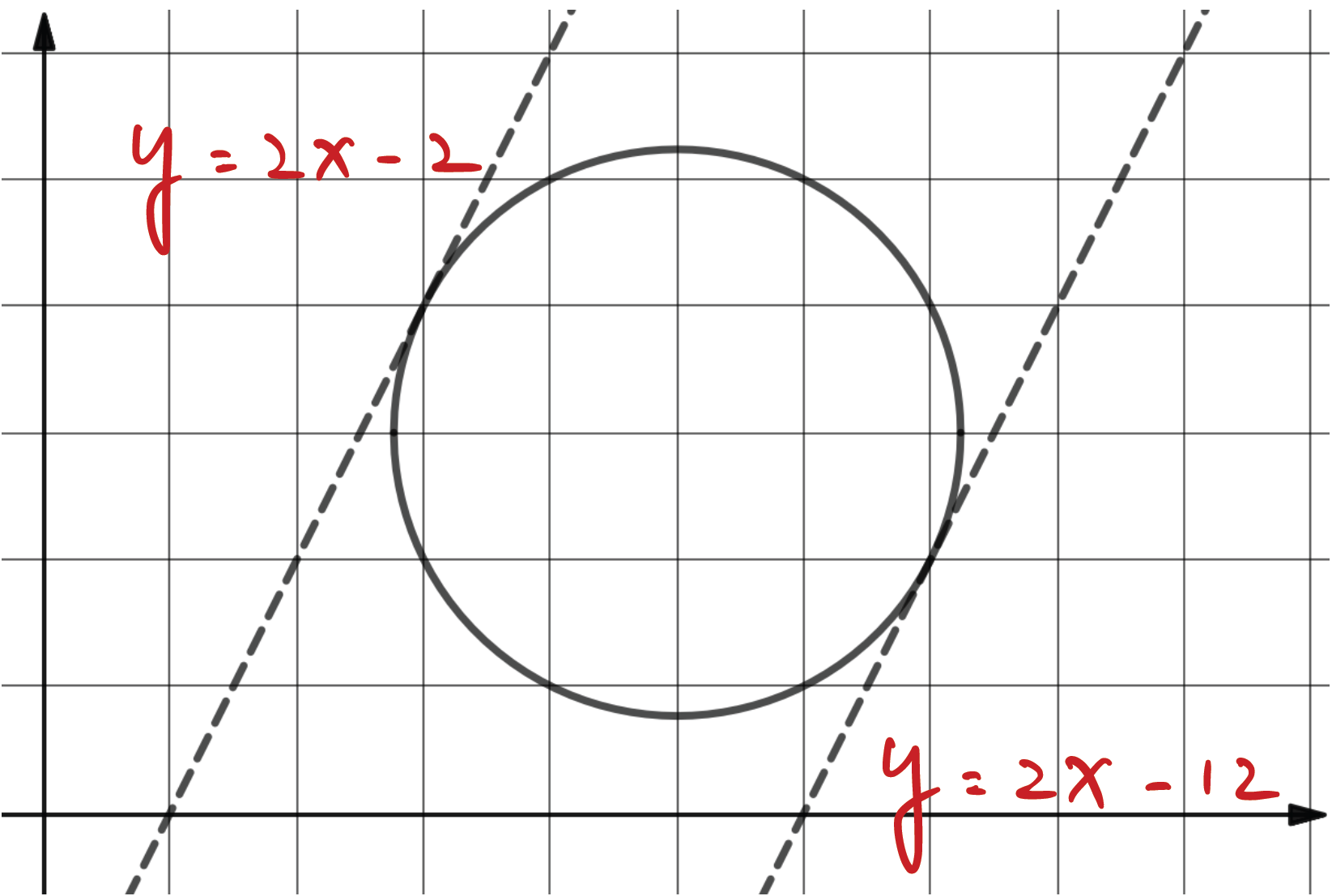
Equation of Tangent to a Circle at a Given Point P ( 3 , 4 ) P(3, 4) P ( 3 , 4 ) ( x − 5 ) 2 + ( y − 3 ) 2 = 5 (x-5)^{2}+(y-3)^{2}=5 ( x − 5 ) 2 + ( y − 3 ) 2 = 5 L L L P P P
Solution centre G = ( 5 , 3 ) G=(5, 3) G = ( 5 , 3 )
Note that P G ⊥ L PG\perp L P G ⊥ L
m L × m P G = − 1 m L × 4 − 3 3 − 5 = − 1 m L = 2 \begin{aligned} m_{L}\times m_{PG} &= -1 \\ m_{L}\times\dfrac{4-3}{3-5} &= -1 \\ m_{L} &= 2 \end{aligned} m L × m P G m L × 3 − 5 4 − 3 m L = − 1 = − 1 = 2
L L L P P P
y − 4 x − 3 = 2 y = 2 x − 2 \begin{aligned} \dfrac{y-4}{x-3} &= 2 \\ y &= 2x-2 \end{aligned} x − 3 y − 4 y = 2 = 2 x − 2
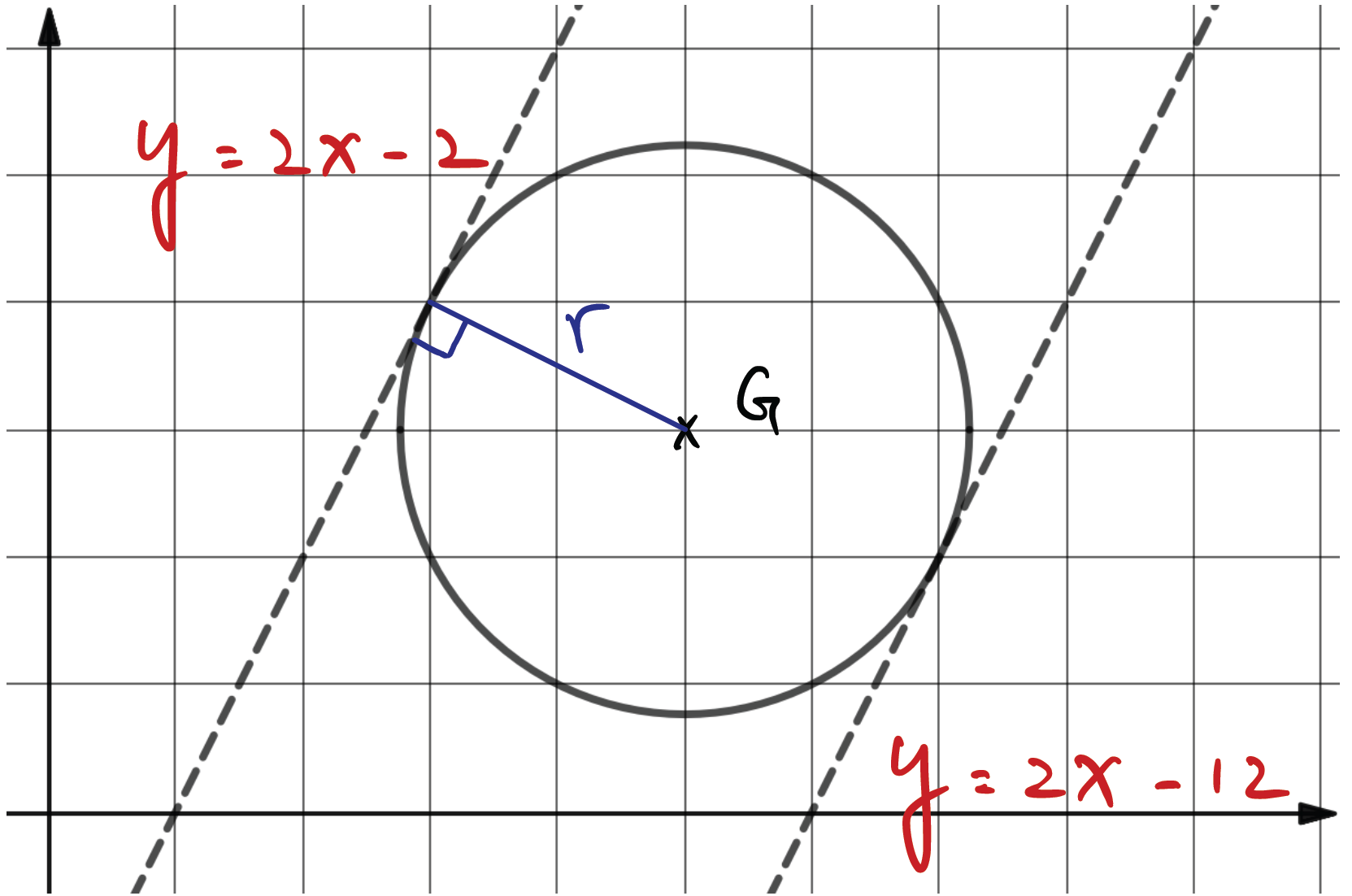
Equation of Tangent to a Circle with a Given Slope Consider the circle ( x − 5 ) 2 + ( y − 3 ) 2 = 5 (x-5)^{2}+(y-3)^{2}=5 ( x − 5 ) 2 + ( y − 3 ) 2 = 5 L L L L L L
Method 1: By Discriminant Let L L L y = 2 x + k y=2x+k y = 2 x + k
Put L L L
( x − 5 ) 2 + ( 2 x + k − 3 ) 2 = 5 ⋮ ← a lot of expanding and simplifying 5 x 2 + ( 4 k − 22 ) x + ( k 2 − 6 k + 29 ) = 0 ← made into the form a x 2 + b x + c = 0 \begin{aligned} (x-5)^{2}+(2x+k-3)^{2} &= 5 \\ &\vdots && \color{red}{\leftarrow \text{ a lot of expanding and simplifying}} \\ 5x^{2}+(4k-22)x+(k^{2}-6k+29) &= 0 && \color{red}{\leftarrow \text{ made into the form } ax^{2}+bx+c=0} \end{aligned} ( x − 5 ) 2 + ( 2 x + k − 3 ) 2 5 x 2 + ( 4 k − 22 ) x + ( k 2 − 6 k + 29 ) = 5 ⋮ = 0 ← a lot of expanding and simplifying ← made into the form a x 2 + b x + c = 0
L L L
Δ = 0 ( 4 k − 22 ) 2 − 4 ( 5 ) ( k 2 − 6 k + 29 ) = 0 ⋮ ← a lot of expanding and simplifying k 2 + 14 k + 24 = 0 k = − 2 or − 12 \begin{aligned} Δ &= 0 \\ (4k-22)^{2}-4(5)(k^{2}-6k+29) &= 0 \\ &\vdots && \color{red}{\leftarrow \text{ a lot of expanding and simplifying}} \\ k^{2}+14k+24 &= 0 \\ k &= -2 \text{ or } -12 \end{aligned} Δ ( 4 k − 22 ) 2 − 4 ( 5 ) ( k 2 − 6 k + 29 ) k 2 + 14 k + 24 k = 0 = 0 ⋮ = 0 = − 2 or − 12 ← a lot of expanding and simplifying
∴ L L L y = 2 x − 2 y=2x-2 y = 2 x − 2 y = 2 x − 12 y=2x-12 y = 2 x − 12
Method 2: By Point-Line Distance Formula (out of syl.) The distance d d d ( X , Y ) (X, Y) ( X , Y ) a x + b y + c = 0 ax+by+c=0 a x + b y + c = 0
d 2 = [ a X + b Y + c ] 2 a 2 + b 2 d^{2}=\dfrac{[aX+bY+c]^{2}}{a^{2}+b^{2}} d 2 = a 2 + b 2 [ a X + bY + c ] 2
we have centre G = ( 5 , 3 ) G=(5, 3) G = ( 5 , 3 ) r = 5 r=\sqrt{5} r = 5
Let L L L y = 2 x + k y=2x+k y = 2 x + k 2 x − y + k = 0 2x-y+k=0 2 x − y + k = 0
Note that the distance from G G G L L L r r r
5 2 = [ 2 ( 5 ) − 3 + k ] 2 2 2 + ( − 1 ) 2 25 = ( 7 + k ) 2 0 = k 2 + 14 k + 24 k = − 2 or − 12 \begin{aligned} \sqrt{5}^{2} &= \dfrac{[2(5)-3+k]^{2}}{2^{2}+(-1)^{2}} \\ 25 &= (7+k)^{2} \\ 0 &= k^{2}+14k+24 \\ k &= -2 \text{ or } -12 \end{aligned} 5 2 25 0 k = 2 2 + ( − 1 ) 2 [ 2 ( 5 ) − 3 + k ] 2 = ( 7 + k ) 2 = k 2 + 14 k + 24 = − 2 or − 12
∴ L L L y = 2 x − 2 y=2x-2 y = 2 x − 2 y = 2 x − 12 y=2x-12 y = 2 x − 12
S5 Dispersion Inter-quartile Range Find the inter-quartile range for
2 7 9 11 13 14 17 23
1 4 10 11 12 18 19 23 28
Solution First find Q 1 Q_{1} Q 1 Q 3 Q_{3} Q 3
The median cuts the data into two equal halves.
Q 1 Q_{1} Q 1 = 8 =8 = 8
Q 3 Q_{3} Q 3 = 15.5 =15.5 = 15.5
∴ I Q R = Q 3 − Q 1 = 7.5 \begin{aligned} IQR &= Q_{3}-Q_{1} \\ &= 7.5 \end{aligned} I QR = Q 3 − Q 1 = 7.5
Q 1 Q_{1} Q 1 = 7 =7 = 7
Q 3 Q_{3} Q 3 = 21 =21 = 21
∴ I Q R = Q 3 − Q 1 = 14 \begin{aligned} IQR &= Q_{3}-Q_{1} \\ &= 14 \end{aligned} I QR = Q 3 − Q 1 = 14
Find Mean and SD from a Pair of z-scores In a test, students A and B get 40 marks and 70 marks respectively. Their standard scores are −1 and 2 respectively.
Find the mean and standard deviation of the marks of the whole class.
Solution { 40 − x ˉ σ = − 1 70 − x ˉ σ = 2 → { 40 − x ˉ = − σ 70 − x ˉ = 2 σ → { x ˉ − σ = 40 x ˉ + 2 σ = 70 \left\{ \begin{aligned} \dfrac{40-\bar{x}}{σ} &= -1 \\ \dfrac{70-\bar{x}}{σ} &= 2 \end{aligned} \right. \to \left\{ \begin{aligned} 40-\bar{x} &= -σ \\ 70-\bar{x} &= 2σ \end{aligned} \right. \to \left\{ \begin{aligned} \bar{x}-σ &= 40 \\ \bar{x}+2σ &= 70 \end{aligned} \right. ⎩ ⎨ ⎧ σ 40 − x ˉ σ 70 − x ˉ = − 1 = 2 → { 40 − x ˉ 70 − x ˉ = − σ = 2 σ → { x ˉ − σ x ˉ + 2 σ = 40 = 70
∴ x ˉ = 50 \bar{x}=50 x ˉ = 50 σ = 10 σ=10 σ = 10
S5 Counting Method of Bundling 3 boys and 7 girls form a queue. If the 3 boys must stand together, how many ways are there?
Solution 綑綁法
Treat the 3 boys as 1 object first. Together with the 7 girls, there are 8 objects now.
Step 1: Order 8 objects (7 girls and 1 box of boys)
Step 2: Order the 3 boys within the box
∴ 8 ! × 3 ! = 241920 8!\times 3!=241920 8 ! × 3 ! = 241920
Method of Insertion 3 boys and 7 girls form a queue. If no boy can stand next to another boy, how many ways are there?
Solution 插空法
Step 1: Order the 7 girls
Step 2: There are 8 spaces among the queue of girls. Choose 3 spaces from them to put in the boys.
Step 3: Order the 3 boys into the spaces
∴ 7 ! × C 3 8 × 3 ! = 1693440 7!\times C_{3}^{8}\times 3!=1693440 7 ! × C 3 8 × 3 ! = 1693440
Successive Selection There are 10 students. To form a committee with 1 chairperson, 2 vice-chairpersons and 3 members, how many ways are there?
Solution Step 1: Select 1 chairperson from 10 students
Step 2: Select 2 vice-chairpersons from the remaining 9 students
Step 3: Select 3 members from the remaining 7 students
∴ C 1 10 × C 2 9 × C 3 7 = 12600 C_{1}^{10}\times C_{2}^{9}\times C_{3}^{7}=12600 C 1 10 × C 2 9 × C 3 7 = 12600
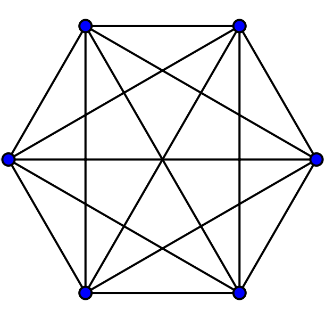
Count the Diagonals in a Polygon Consider a regular hexagonal (6 sides). How many diagonals are there?
‘diagonal’ is a straight line connecting any two non-adjacent vertices.
Solution
If we connect any two vertices by a line, there will be C 2 6 = 15 C_{2}^{6}=15 C 2 6 = 15
However, 6 of those lines are the 6 sides. 其中6條係本身六邊形的邊
∴ There are 15 − 6 = 9 15-6=9 15 − 6 = 9