Maths Demo (II)
S4 Quadratic Function
Common Expressions of Roots
α and β are the roots of 2x2+10x+6=0. Find the value of
α2+β2
(α−β)2
α3+β3
Solution
sum of root: α+β=−210=−5
product of root: αβ=26=3
α2+β2=α2+2αβ+β2−2αβ=(α+β)2−2αβ=(−5)2−2(3)=19
(α−β)2=α2−2αβ+β2=α2+2αβ+β2−4αβ=(α+β)2−4αβ=(−5)2−4(3)=13
α3+β3=(α+β)(α2−αβ+β2)=(−5)(α2+β2−3)=(−5)(19−3)=−80←by (a)
Completing the Square
Complete the square for
x2−10x
2x2−20x+5
Solution
This is a simple version of completing the square.
x2−10x=x2−2(5)x=x2−2(5)x+52−52=(x−5)2−25
This is a general version of completing the square.
2x2−20x+5=2[x2−10x]+5=2[(x−5)2−25]+5=2(x−5)2−45←isolate out a simple version←by (a)
Find Vertex
Find the coordinates of the vertex of y=2x2−20x+5.
Method 1: By Formula
Let vertex = (h,k)
h=−2ab=−2(2)−20=5
Put (5,k) into the equation:
k=2(5)2−20(5)+5=−45
∴ (5,−45)
Method 2: By Completing the Square (Slow!)
By completing the square, convert the equation to vertex form:
2x2−20x+5=…=2(x−5)2−45
∴ (5,−45) ← read off from vertex form a(x−h)2+k
S4 Complex Number
Power of i
Simplify
i4
i23
i−1
Solution
i4=i2i2=(−1)(−1)=1
i23=i4i4i4i4i4i3=i3=i2i=−i←i4=1
i−1=i1×ii=i2i=−1i=−i
Rationalize a Complex Number
Express 2+i1 in the form of a+bi.
Solution
2+i1×2−i2−i=(2+i)(2−i)2−i=22−i22−i=4−(−1)2−i=52−i=52−51i
S4 Equations of Straight Line
Distance between a Point and a Line
Given a point P(5,3) and a straight line L: y=2x+3. Find the distance between P and L.
Method 1: By Perpendicular Distance
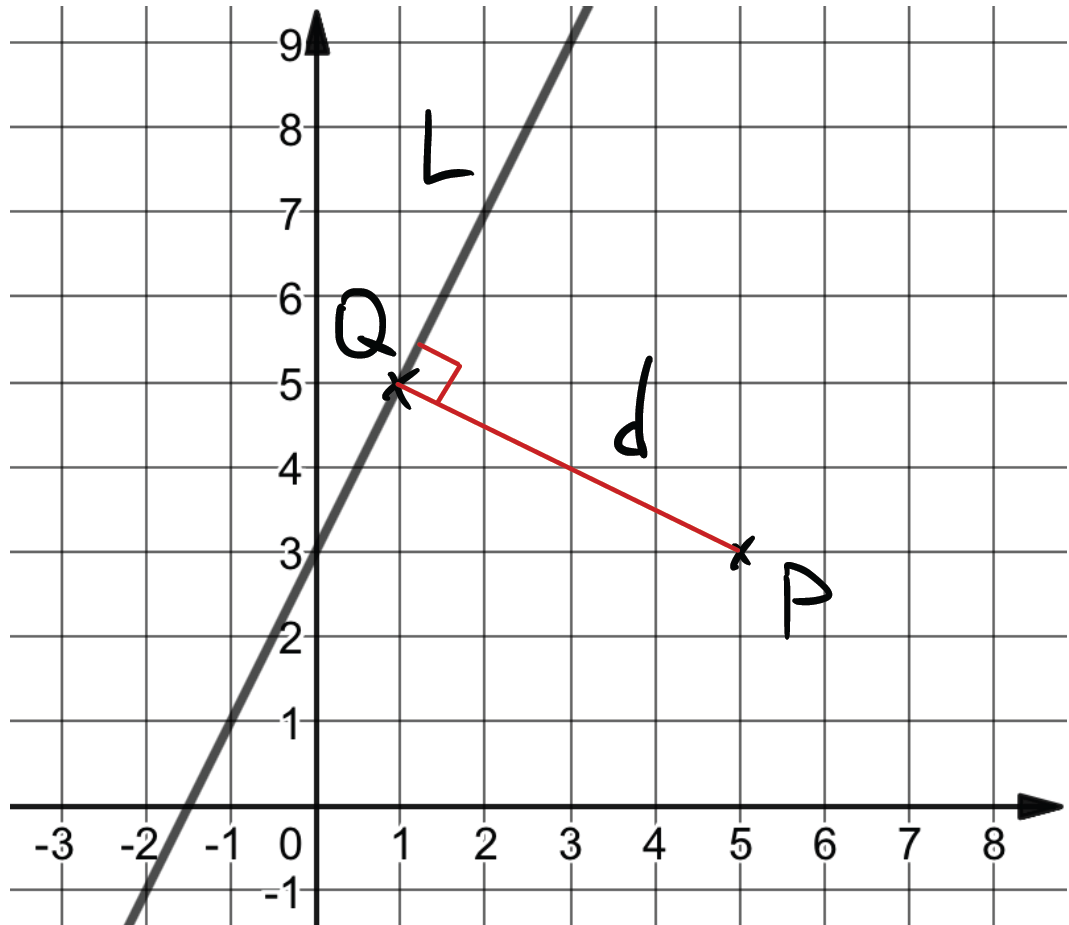
The ‘distance’ between a point and a line means the shortest distance, which is also the perpendicular distance.
∴ distance between P and L = PQ, where PQ⊥L
Find the equation of PQ:
mPQ×mLmPQ×2mPQ=−1=−1=2−1
∴ x−5y−3y=−0.5=−0.5x+5.5
Find the coordinates of Q:
{yy=2x+3...L=−0.5x+5.5...PQ
∴ Q=(1,5) ← Q is the intersection of L and PQ
Find distance PQ:
PQ=(5−1)2+(3−5)2=20
Method 2: By Point-Line Distance Formula (Out of Syl.)
The distance d between a point (X,Y) and a straight line ax+by+c=0 is given by:
d2=a2+b2[aX+bY+c]2
The distance between P(5,3) and L: 2x−y+3=0 is given by:
d2d=22+(−1)2[2(5)+(−1)(3)+3]2=20=20
S4 Polynomials
Find Unknown Constants by Remainder Theorem
Let f(x)=2x3+ax2+bx−1.
When f(x) is divided by x+2, the remainder is −5. Also, f(x) is divisible by 2x−1. Find a and b.
Solution
⎩⎨⎧f(−2)f(21)=−5=0→⎩⎨⎧2(−2)3+a(−2)2+b(−2)−12(21)3+a(21)2+b(21)−1=−5=0→{4a−2b0.25a+0.5b=12=0.75
Solving, a=3 and b=0. ← by calculator program
HCF and LCM of Polynomials
Find the HCF and LCM of xy4, x3y2 and x2y3z.
Solution
HCFLCM==xx3x2xx3y4y2y3y2y4zztake the lowest powertake the highest power
Long Division
Find the quotient and remainder for
(2x3+x2−2x+10)÷(x+2)
(x4+5x2+x+3)÷(x2+x)
Solution
2x2x+2)2x32x3−3x+x2+4x2−3x2−3x2+4−2x−2x−6x4x4x+10+10+82
∴ quotient =2x2−3x+4, remainder =2
x2x2+x)x4x4−x+0x3+x3−x3−x3+6+5x2+0x2+5x2−x26x26x2+x+x+0x+x+6x−5x+3+3+0+3
←記得補零!
∴ quotient =x2−x+6, remainder =−5x+3
Factorize Cubic Polynomial
Let f(x)=x3+4x2+x−6. Given that x+2 is a factor of f(x), factorize f(x).
Solution
∵ f(x)=(x+2)Q(x) ← since x+2 is a factor
∴ Q(x)=f(x)÷(x+2)=x2+2x−3 ← by long division
∴ f(x)=(x+2)(x2+2x−3)=(x+2)(x−1)(x+3) ← by cross method
Solve Cubic Equation
Let f(x)=x3+4x2+x−6. Given that x+2 is a factor of f(x), solve f(x)=0.
Solution
f(x)(x+2)(x2+2x−3)=0=0 ← factorize f(x)
∴ x+2=0 or x2+2x−3=0
x=−2, x=1 or −3
∴ x=−2, 1 or −3
S4 Exponentials and Logarithms
Solve Exponential Equation
Solve
2x=3
2x−1+2x+1=20
4x−3(2x)−10=0
Solution
2xx=3=log23=1.58
2x−1+2x+1(2x)(2−1)+(2x)(21)(2x)(0.5)+(2x)(2)2.5(2x)2xx=20=20=20=20=8=log28=3
4x−3(2x)−10(2x)2−3(2x)−102xx=0=0=5 or −2 (rej.)=log25=2.32←4x=(22)x=22x=(2x)2←2x is positive
Express y=2x3 in the form of logy=mlogx+c.
Express y=2(3x) in the form of logy=mx+c.
Solution
Take log on both sides
logy=log(2x3)=log2+logx3=log2+3logx=3logx+log2
logy=log(2(3x))=log2+log3x=log2+xlog3=(log3)x+log2
Express logy=2logx+3 in the form of y=axb.
Express logy=2x+3 in the form of y=a(bx).
Method 1: Direct Method
(策略係將RHS combine做一個log)
logy=2logx+3=logx2+3=logx2+log103=log(x2×103)=log(1000x2)
∴ y=1000x2
logy=2x+3=(log102)x+log103=(log100)x+log1000=log100x+log1000=log(100x×1000)
∴ y=1000(100x)
Method 2: Reverse Method
(策略係將個result寫返做logarithmic form然後Compare Term)
y=axb
logy=log(axb)=blogx+loga
Compare with logy=2logx+3,
we have b=2 and logaa=3=103=1000
∴ y=1000x2
y=a(bx)
logy=log(a(bx))=(logb)x+loga
Comparing with logy=2x+3,
we have logbb=2=102=100 and logaa=3=103=1000
∴ y=1000(100x)
S4 Intersections of Straight Line and Parabola
Mid-point of Intersections
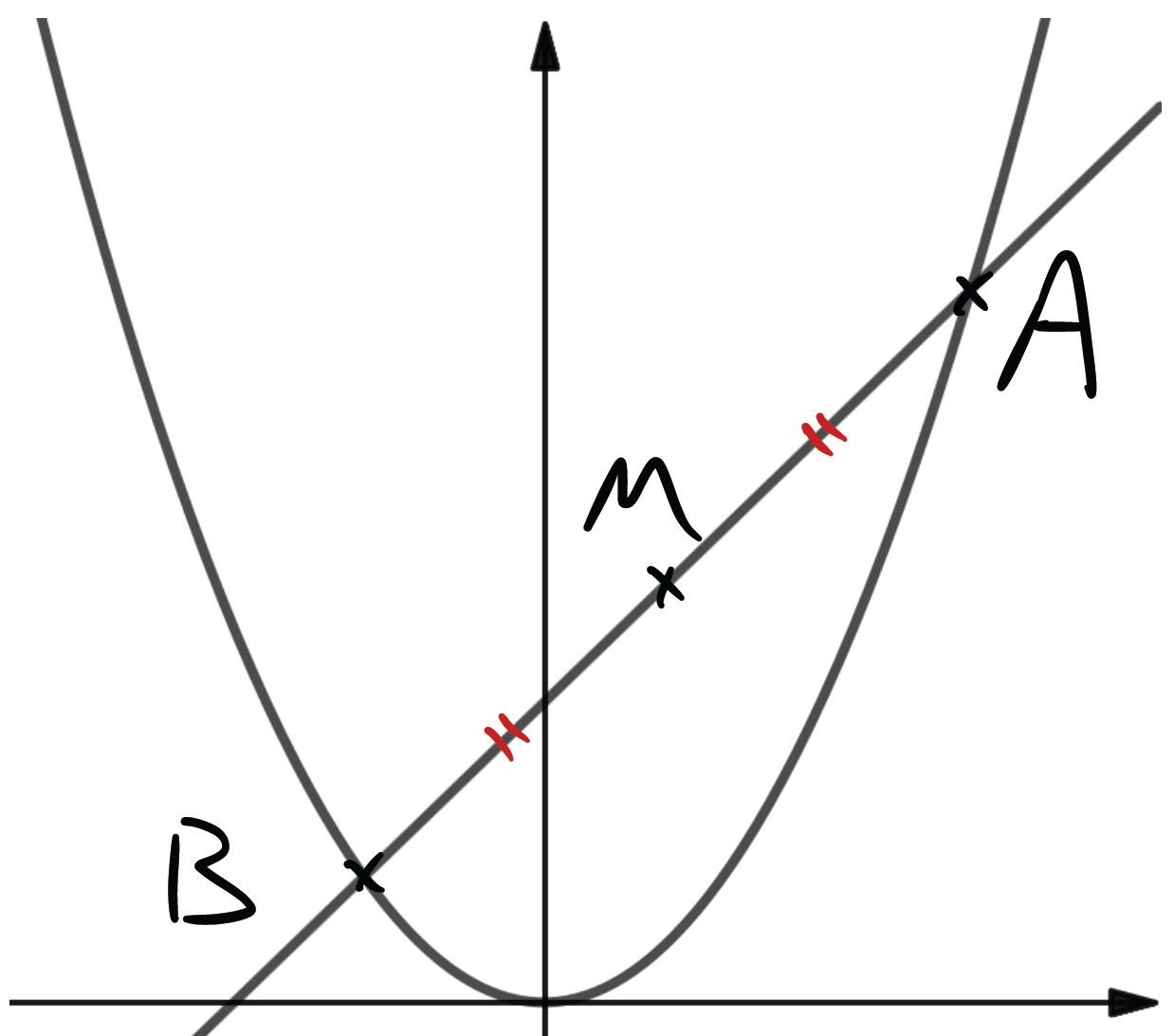
The straight line y=2x+k cuts the parabola y=x2 at A and B.
Find the coordinates of the mid-point M of AB in terms of k.
Solution
Let A=(α,?), B=(β,?) and M=(m,n)
Put y=2x+k into y=x2:
2x+k0=x2=x2−2x−k
∵ α and β are the roots of this equation
∴ m=2α+β=2−(−2)/1=1 ← sum of roots
Put M=(1,n) into y=2x+k: ← M lies on the straight line
n=2(1)+k=2+k
∴ M=(1,2+k)
Horizontal Distance between Intersections
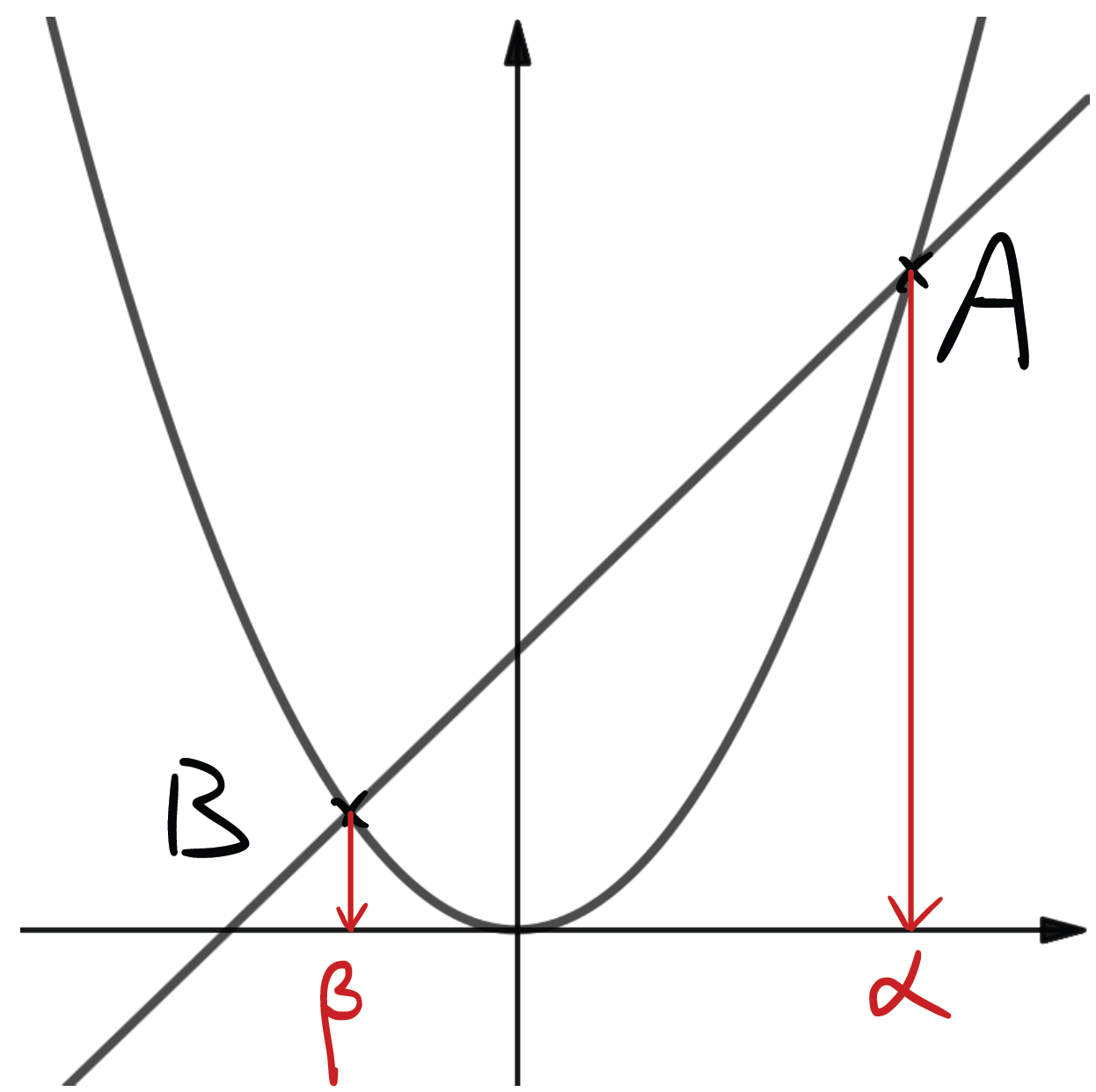
The straight line y=2x+k cuts the parabola y=x2 at A and B.
Find the horizontal distance between A and B in terms of k.
Solution
Let A=(α,?) and B=(β,?).
The horizontal distance is α−β
Put y=2x+k into y=x2:
2x+k0=x2=x2−2x−k
∵ α and β are the roots of this equation
∴ α+β=1−(−2)=2 and αβ=1−k=−k ← sum and product of roots
∴ (α−β)2α−β=α2−2αβ+β2=α2+2αβ+β2−4αβ=(α+β)2−4αβ=(2)2−4(−k)=4+4k=4+4k
S4 Variations
Joint Variation
z varies directly as x2 and inversely as y. When x=2 and y=3, we have z=8. Express z in terms of x and y.
Solution
Let z=ykx2 for some constant k
Put x=2, y=3 and z=8:
8k=3k(2)2=6
∴ z=y6x2
Partial Variation
y partly varies as x and partly varies as x2. When x=1, y=5. When x=2, y=16. Express y in terms of x.
Solution
Let y=k1x+k2x2 for some constants k1 and k2
{516=k1(1)+k2(1)2=k1(2)+k2(2)2... when x=1, y=5... when x=2, y=16
∴ k1=2, k2=3 ← by calculator program
∴ y=2x+3x2