Maths Demo (I) S1 Estimation Rounding Consider the numbers 6.1 , 6.4 , 6.5 , 6.9.
Round off the numbers to the nearest integer.
Round up the numbers to the nearest integer.
Round down the numbers to the nearest integer.
Solution 6 , 6 , 7 , 7 四捨五入
7 , 7 , 7 , 7 無論如何,進位
6 , 6 , 6 , 6 無論如何,捨去
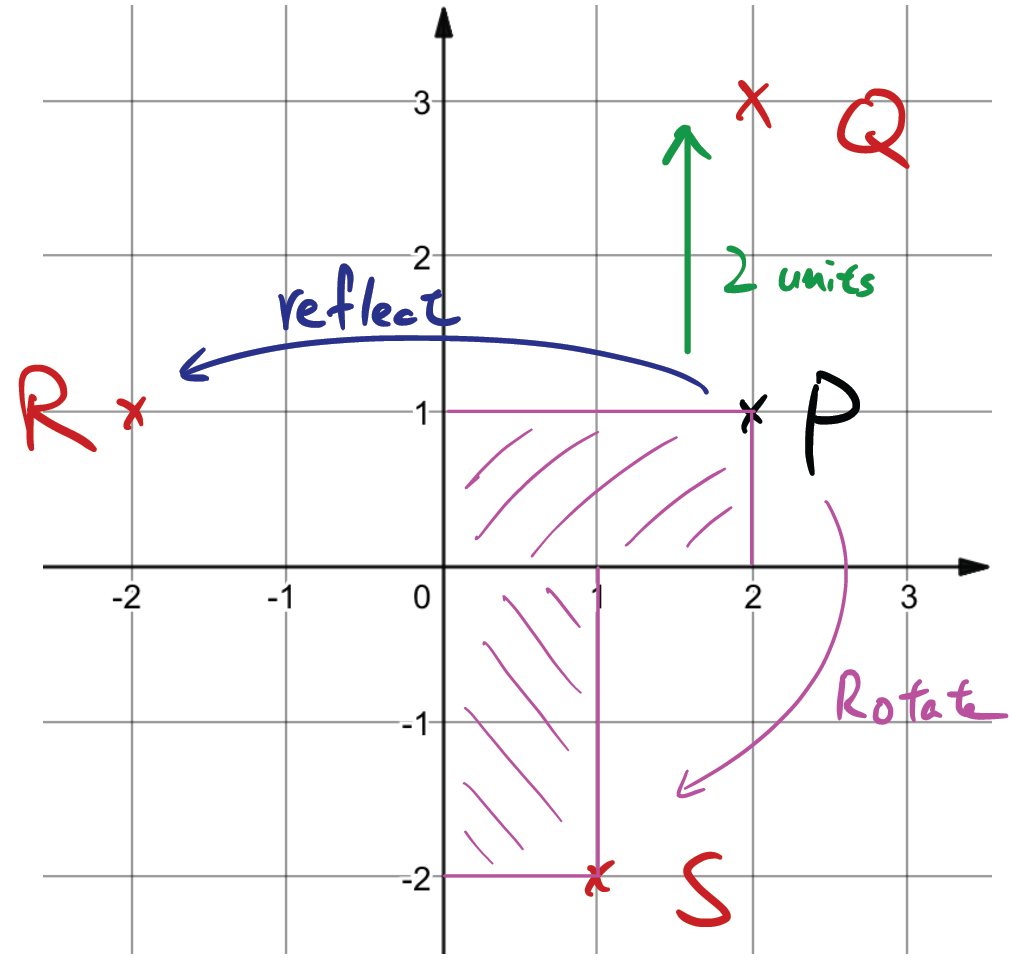
S1 Basic Coordinate Geometry Translate / Reflect / Rotate a Point Given P ( 2 , 1 ) P(2, 1) P ( 2 , 1 )
Translate P P P Q Q Q
Reflect P P P y y y R R R
Rotate P P P S S S
Solution
Q = ( 2 , 3 ) Q=(2, 3) Q = ( 2 , 3 )
R = ( − 2 , 1 ) R=(-2, 1) R = ( − 2 , 1 )
S = ( 1 , − 2 ) S=(1, -2) S = ( 1 , − 2 )
S2 Identity Find Unknown Constants in Identity Given ( x − 2 ) ( x + a ) − 3 b x + b ≡ x ( x − 18 ) − 3 (x-2)(x+a)-3bx+b\equiv x(x-18)-3 ( x − 2 ) ( x + a ) − 3 b x + b ≡ x ( x − 18 ) − 3 a a a b b b
Method 1: Compare Terms ( x − 2 ) ( x + a ) − 3 b x + b ≡ x ( x − 18 ) − 3 x 2 − 2 x + a x − 2 a − 3 b x + b ≡ x 2 − 18 x − 3 ← expand both sides x 2 + ( a − 3 b − 2 ) x + ( b − 2 a ) ≡ x 2 − 18 x − 3 \begin{aligned} (x-2)(x+a)-3bx+b &\equiv x(x-18)-3 \\ x^{2}-2x+ax-2a-3bx+b &\equiv x^{2}-18x-3 && \leftarrow \text{expand both sides} \\ x^{2}+(a-3b-2)x+(b-2a) &\equiv x^{2}-18x-3 \end{aligned} ( x − 2 ) ( x + a ) − 3 b x + b x 2 − 2 x + a x − 2 a − 3 b x + b x 2 + ( a − 3 b − 2 ) x + ( b − 2 a ) ≡ x ( x − 18 ) − 3 ≡ x 2 − 18 x − 3 ≡ x 2 − 18 x − 3 ← expand both sides
Compare x x x a − 3 b − 2 = − 18 a-3b-2=-18 a − 3 b − 2 = − 18
Compare constant term: b − 2 a = − 3 b-2a=-3 b − 2 a = − 3
Solving, a = 5 a=5 a = 5 b = 7 b=7 b = 7
Method 2: Kill x Put x = 2 x=2 x = 2
( 2 − 2 ) ( 2 + a ) − 3 b ( 2 ) + b = 2 ( 2 − 18 ) − 3 − 5 b = − 35 b = 7 \begin{aligned} (2-2)(2+a)-3b(2)+b &= 2(2-18)-3 \\ -5b &= -35 \\ b &= 7 \end{aligned} ( 2 − 2 ) ( 2 + a ) − 3 b ( 2 ) + b − 5 b b = 2 ( 2 − 18 ) − 3 = − 35 = 7
Put x = 0 x=0 x = 0
( 0 − 2 ) ( 0 + a ) − 3 b ( 0 ) + b = 0 ( 0 − 18 ) − 3 − 2 a + b = − 3 a = 5 \begin{aligned} (0-2)(0+a)-3b(0)+b &= 0(0-18)-3 \\ -2a+b &= -3 \\ a &= 5 \end{aligned} ( 0 − 2 ) ( 0 + a ) − 3 b ( 0 ) + b − 2 a + b a = 0 ( 0 − 18 ) − 3 = − 3 = 5
S3 Factorization Cross Method by Calculator Factorize
x 2 + x − 6 x^{2}+x-6 x 2 + x − 6
x 2 + x y − 6 y 2 x^{2}+xy-6y^{2} x 2 + x y − 6 y 2
Solution ∵ The roots of x 2 + x − 6 = 0 x^{2}+x-6=0 x 2 + x − 6 = 0 x 2 + x − 6 = ( x − 2 ) ( x + 3 ) x^{2}+x-6=(x-2)(x+3) x 2 + x − 6 = ( x − 2 ) ( x + 3 )
x 2 + x y − 6 y 2 = ( x − 2 y ) ( x + 3 y ) x^{2}+xy-6y^{2}=(x-2y)(x+3y) x 2 + x y − 6 y 2 = ( x − 2 y ) ( x + 3 y ) y y y
Factorize
2 x 2 + 5 x − 12 2x^{2}+5x-12 2 x 2 + 5 x − 12
2 x 2 + 5 x y − 12 y 2 2x^{2}+5xy-12y^{2} 2 x 2 + 5 x y − 12 y 2
Solution ∵ The roots of 2 x 2 + 5 x − 12 = 0 2x^{2}+5x-12=0 2 x 2 + 5 x − 12 = 0 3 2 \dfrac{3}{2} 2 3 2 x 2 + 5 x − 12 = 2 ( x − 3 2 ) ( x + 4 ) = ( 2 x − 3 ) ( x + 4 ) \begin{aligned} 2x^{2}+5x-12 &= 2(x-\dfrac{3}{2})(x+4) \\ &= (2x-3)(x+4) \end{aligned} 2 x 2 + 5 x − 12 = 2 ( x − 2 3 ) ( x + 4 ) = ( 2 x − 3 ) ( x + 4 )
2 x 2 + 5 x y − 12 y 2 = ( 2 x − 3 y ) ( x + 4 y ) 2x^{2}+5xy-12y^{2}=(2x-3y)(x+4y) 2 x 2 + 5 x y − 12 y 2 = ( 2 x − 3 y ) ( x + 4 y )
S2 Ratio Read a Ratio If a 2 = b 3 \dfrac{a}{2}=\dfrac{b}{3} 2 a = 3 b a : b a:b a : b
If 3 a = 7 b 3a=7b 3 a = 7 b a : b a:b a : b
If a 2 = b 3 = c 5 \dfrac{a}{2}=\dfrac{b}{3}=\dfrac{c}{5} 2 a = 3 b = 5 c a : b : c a:b:c a : b : c
Solution 分子:分子 = 分母:分母
a : b = 2 : 3 a:b=2:3 a : b = 2 : 3
3 a = 7 b a 7 = b 3 \begin{aligned} 3a &= 7b \\ \dfrac{a}{7} &= \dfrac{b}{3} \end{aligned} 3 a 7 a = 7 b = 3 b a : b = 7 : 3 a:b=7:3 a : b = 7 : 3
a : b : c = 2 : 3 : 5 a:b:c=2:3:5 a : b : c = 2 : 3 : 5
k -method If a : b = 2 : 3 a:b=2:3 a : b = 2 : 3 a + 2 b = 56 a+2b=56 a + 2 b = 56 a a a b b b
Solution Let a = 2 k a=2k a = 2 k b = 3 k b=3k b = 3 k
2 k + 2 ( 3 k ) = 56 k = 7 \begin{aligned} 2k+2(3k) &= 56 \\ k &= 7 \end{aligned} 2 k + 2 ( 3 k ) k = 56 = 7
∴ a = 2 k = 14 b = 3 k = 21 \begin{aligned} a &= 2k \\ &= 14 \\ b &= 3k \\ &= 21 \end{aligned} a b = 2 k = 14 = 3 k = 21
S3 Number System Convert to Base 10 Convert 11001 2 11001_{2} 1100 1 2
Convert AB85 16 \text{AB85}_{16} AB85 16
Solution 11001 2 = 1 − × 2 4 + 1 − × 2 3 + 0 − × 2 2 + 0 − × 2 1 + 1 − × 2 0 = 25 \begin{aligned} 11001_{2} &= \underset{\scriptscriptstyle-}{1}\times 2^{4}+\underset{\scriptscriptstyle-}{1}\times 2^{3}+\underset{\scriptscriptstyle-}{0}\times 2^{2}+\underset{\scriptscriptstyle-}{0}\times 2^{1}+\underset{\scriptscriptstyle-}{1}\times 2^{0} \\ &= 25 \end{aligned} 1100 1 2 = − 1 × 2 4 + − 1 × 2 3 + − 0 × 2 2 + − 0 × 2 1 + − 1 × 2 0 = 25
AB85 16 = 10 ‾ × 16 3 + 11 ‾ × 16 2 + 8 ‾ × 16 1 + 5 ‾ × 16 0 = 43909 \begin{aligned} \text{AB85}_{16} &= \underline{10}\times 16^{3}+\underline{11}\times 16^{2}+\underline{8}\times 16^{1}+\underline{5}\times 16^{0} \\ &= 43909 \end{aligned} AB85 16 = 10 × 1 6 3 + 11 × 1 6 2 + 8 × 1 6 1 + 5 × 1 6 0 = 43909
Convert from Base 10 Convert 25 to binary base (base 2).
Convert 43909 to hexadecimal base (base 16).
Solution 短除法,由下至上讀result
25 = 11001 2 25=11001_{2} 25 = 1100 1 2
2 25 ‾ 25 2 25 ‾ 12 … 1 2 25 ‾ 6 … 0 2 25 ‾ 3 … 0 25 1 … 1 \begin{array}{r|r} 2 & \underline{\phantom{25}}\llap{25} \\ 2 & \underline{\phantom{25}}\llap{12}\rlap{\;\ldots\,1} \\ 2 & \underline{\phantom{25}}\llap{6}\rlap{\;\ldots\,0} \\ 2 & \underline{\phantom{25}}\llap{3}\rlap{\;\ldots\,0} \\ & \phantom{25}\llap{1}\rlap{\;\ldots\,1} \end{array} 2 2 2 2 25 25 25 12 … 1 25 6 … 0 25 3 … 0 25 1 … 1
43909 = AB85 16 43909=\text{AB85}_{16} 43909 = AB85 16
16 43909 ‾ 43909 16 43909 ‾ 2744 … 5 16 43909 ‾ 171 … 8 43909 10 … 11 \begin{array}{r|r} 16 & \underline{\phantom{43909}}\llap{43909} \\ 16 & \underline{\phantom{43909}}\llap{2744}\rlap{\;\ldots\,5} \\ 16 & \underline{\phantom{43909}}\llap{171}\rlap{\;\ldots\,8} \\ & \phantom{43909}\llap{10}\rlap{\;\ldots\,11} \end{array} 16 16 16 43909 43909 43909 2744 … 5 43909 171 … 8 43909 10 … 11
10 = A A A B B B
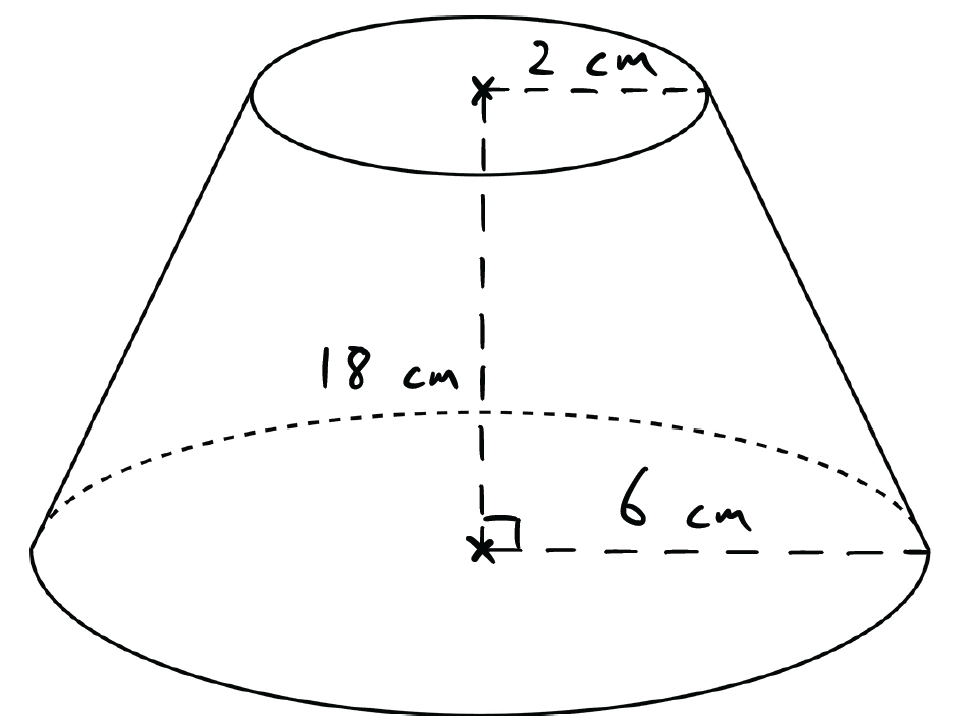
S3 Area and Volume Volume of Frustum Find the volume of this frustum.
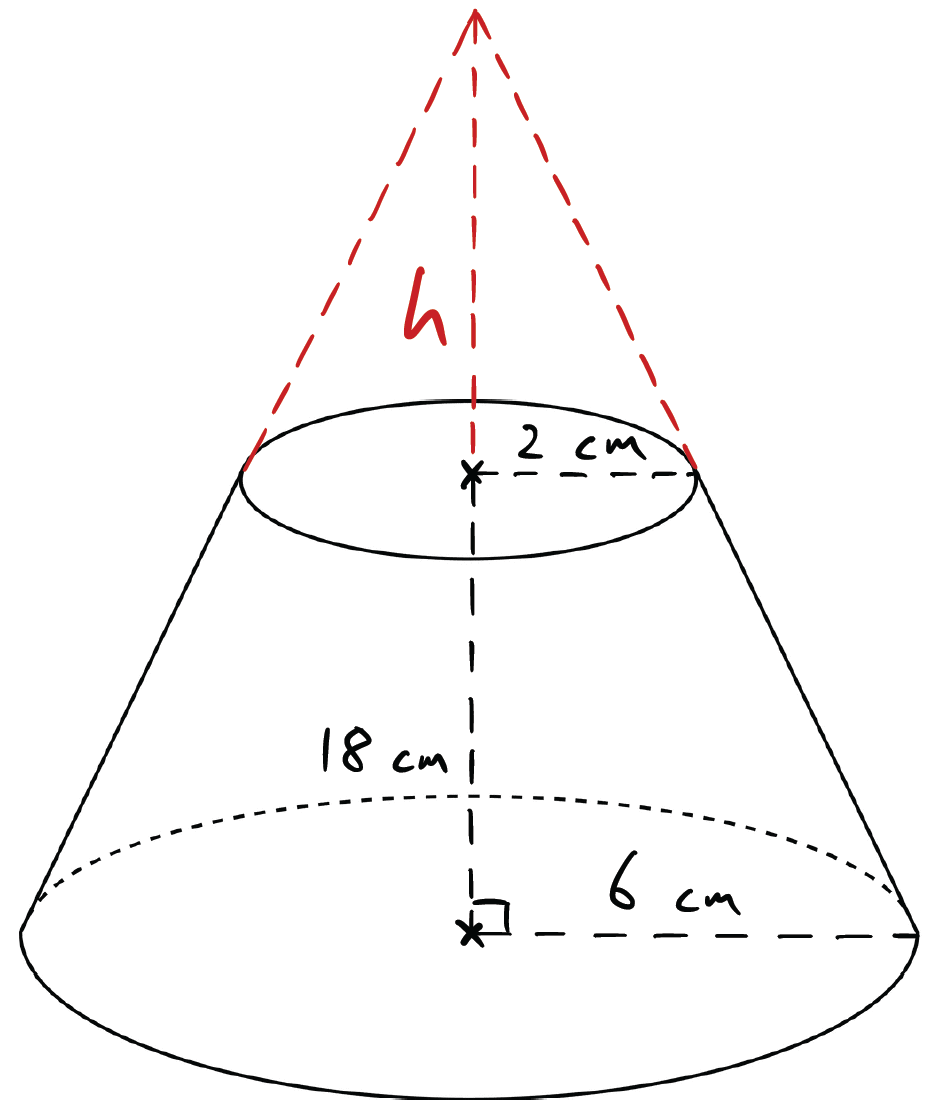
Solution A frustum is formed by cutting off a smaller cone from a larger cone.
h h + 18 = 2 6 h = 9 \begin{aligned} \dfrac{h}{h+18} &= \dfrac{2}{6} \\ h &= 9 \end{aligned} h + 18 h h = 6 2 = 9
Volume of smaller cone = 1 3 π ⋅ 2 2 ⋅ 9 = 12 π \begin{aligned} \text{Volume of smaller cone} &= \dfrac{1}{3}π \cdot 2^{2}\cdot 9 \\ &= 12π \end{aligned} Volume of smaller cone = 3 1 π ⋅ 2 2 ⋅ 9 = 12 π
Volume of larger cone = 1 3 π ⋅ 6 2 ⋅ ( 9 + 18 ) = 324 π \begin{aligned} \text{Volume of larger cone} &= \dfrac{1}{3}π \cdot 6^{2}\cdot (9+18) \\ &= 324π \end{aligned} Volume of larger cone = 3 1 π ⋅ 6 2 ⋅ ( 9 + 18 ) = 324 π
∴ Volume of frustum = 324 π − 12 π = 312 π cm 3 \begin{aligned} \text{Volume of frustum} &= 324π-12π \\ &= 312π \text{ cm}^{3} \end{aligned} Volume of frustum = 324 π − 12 π = 312 π cm 3
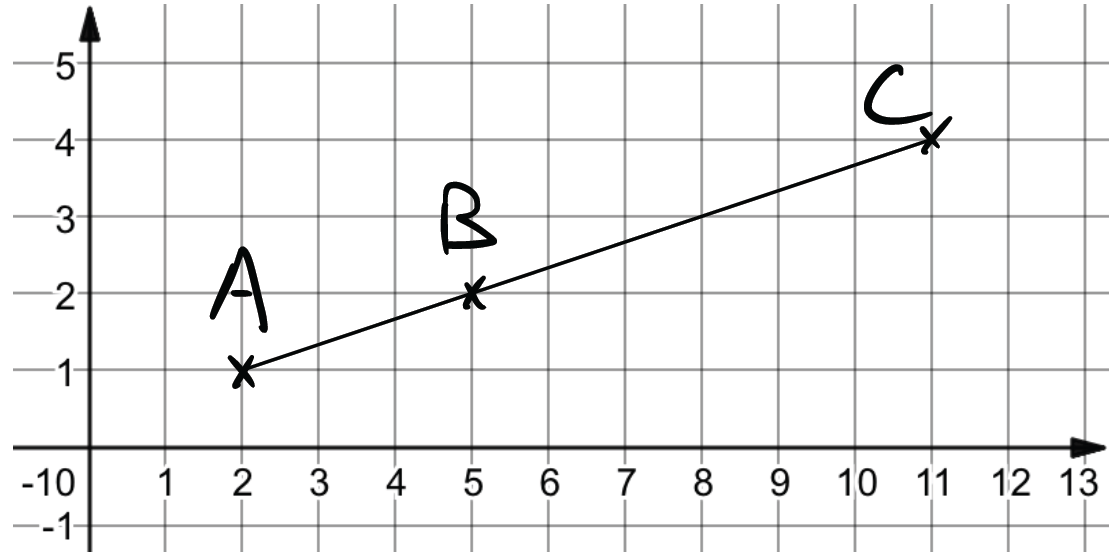
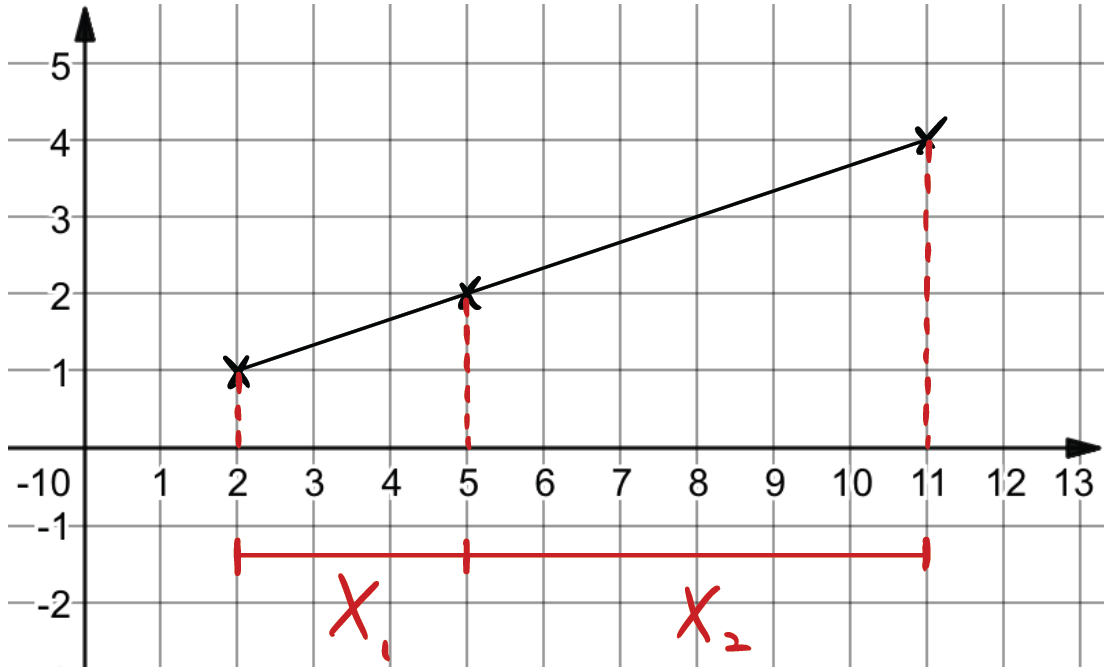
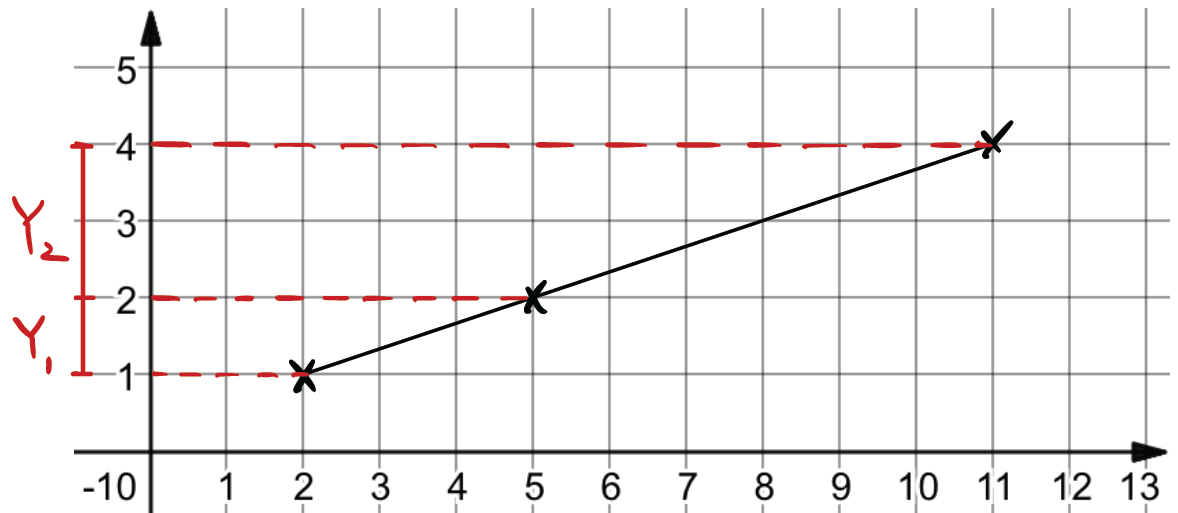
S3 Basic Coordinate Geometry Length Ratio of Segment (影比例法) Given A ( 2 , 1 ) A(2, 1) A ( 2 , 1 ) B ( 5 , 2 ) B(5, 2) B ( 5 , 2 ) C ( 11 , 4 ) C(11, 4) C ( 11 , 4 ) A B C ABC A B C A B : B C AB:BC A B : B C
Method 1: Distance Formula (SLOW!) A B : B C = ( 5 − 2 ) 2 + ( 2 − 1 ) 2 : ( 11 − 5 ) 2 + ( 4 − 2 ) 2 = 10 : 40 = 10 : 2 10 = 1 : 2 \begin{aligned} AB:BC &= \sqrt{(5-2)^{2}+(2-1)^{2}}:\sqrt{(11-5)^{2}+(4-2)^{2}} \\ &= \sqrt{10}:\sqrt{40} \\ &= \sqrt{10}:2\sqrt{10} \\ &= 1:2 \end{aligned} A B : B C = ( 5 − 2 ) 2 + ( 2 − 1 ) 2 : ( 11 − 5 ) 2 + ( 4 − 2 ) 2 = 10 : 40 = 10 : 2 10 = 1 : 2
Method 2: Shadow on x-axis A B : B C = X 1 : X 2 = ( 5 − 2 ) : ( 11 − 5 ) = 3 : 6 = 1 : 2 \begin{aligned} AB:BC &= X_{1}:X_{2} \\ &= (5-2):(11-5) \\ &= 3:6 \\ &= 1:2 \end{aligned} A B : B C = X 1 : X 2 = ( 5 − 2 ) : ( 11 − 5 ) = 3 : 6 = 1 : 2 x x x
Method 3: Shadow on y-axis A B : B C = Y 1 : Y 2 = ( 2 − 1 ) : ( 4 − 2 ) = 1 : 2 \begin{aligned} AB:BC &= Y_{1}:Y_{2} \\ &= (2-1):(4-2) \\ &= 1:2 \end{aligned} A B : B C = Y 1 : Y 2 = ( 2 − 1 ) : ( 4 − 2 ) = 1 : 2
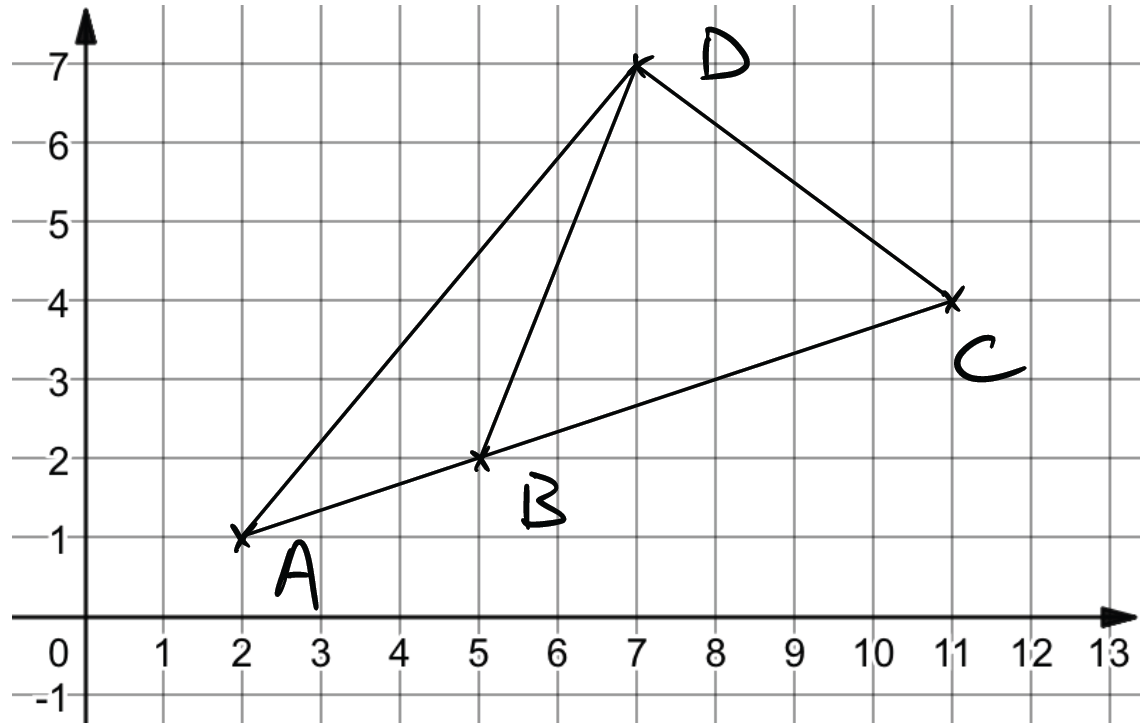
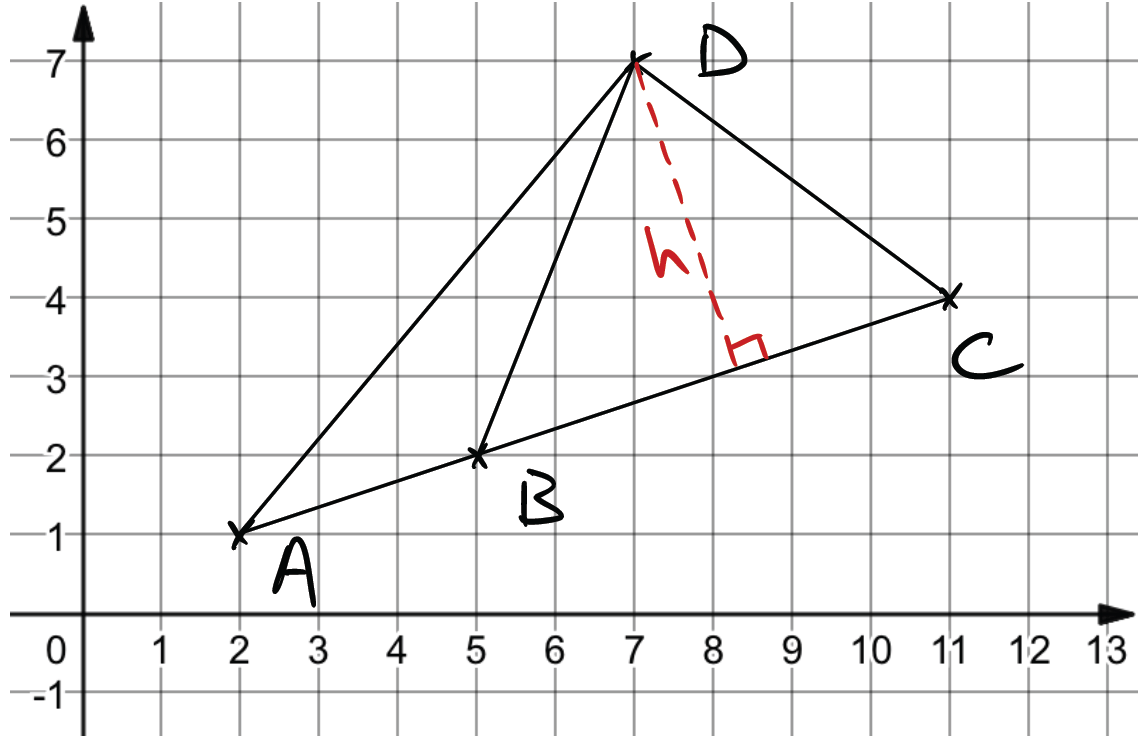
Area Ratio of Adjacent Triangles (同高異底) Given A ( 2 , 1 ) A(2, 1) A ( 2 , 1 ) B ( 5 , 2 ) B(5, 2) B ( 5 , 2 ) C ( 11 , 4 ) C(11, 4) C ( 11 , 4 ) D D D A B C ABC A B C △ A B D \triangle ABD △ A B D △ B C D \triangle BCD △ B C D
Solution If A B AB A B B C BC B C h h h
Area of Δ A B D : Δ B C D = 1 2 × A B × h : 1 2 × B C × h = A B : B C = 1 : 2 \begin{aligned} \text{Area of }Δ ABD:Δ BCD &= \dfrac{1}{2}\times AB\times h:\dfrac{1}{2}\times BC\times h \\ &= AB:BC \\ &= 1:2 \end{aligned} Area of Δ A B D : Δ B C D = 2 1 × A B × h : 2 1 × B C × h = A B : B C = 1 : 2
S3 Statistics Composite Mean Problem There are 40 boys and 60 girls in a school. The mean height of the boys is 150 cm. The mean height of all the students is 144 cm. Find the mean height of the girls.
Solution Let the mean height of the girls be m m m
sum of height of boys + sum of height of girls 100 = 144 40 × 150 + 60 × m 100 = 144 m = 140 cm \begin{aligned} \dfrac{\text{sum of height of boys}+\text{sum of height of girls}}{100} &= 144 \\ \dfrac{40\times 150+60\times m}{100} &= 144 \\ m &= 140\text{ cm} \end{aligned} 100 sum of height of boys + sum of height of girls 100 40 × 150 + 60 × m m = 144 = 144 = 140 cm
S3 Probability Expected Value In a game, there is a 50% chance of winning $1, a 30% chance of winning $5 and a 20% chance of winning $10.
Find the expected value of the prize.
Solution ( 0.5 ) ( 1 ) + ( 0.3 ) ( 5 ) + ( 0.2 ) ( 10 ) = $ 4 (0.5)(1)+(0.3)(5)+(0.2)(10)=\$4 ( 0.5 ) ( 1 ) + ( 0.3 ) ( 5 ) + ( 0.2 ) ( 10 ) = $4